
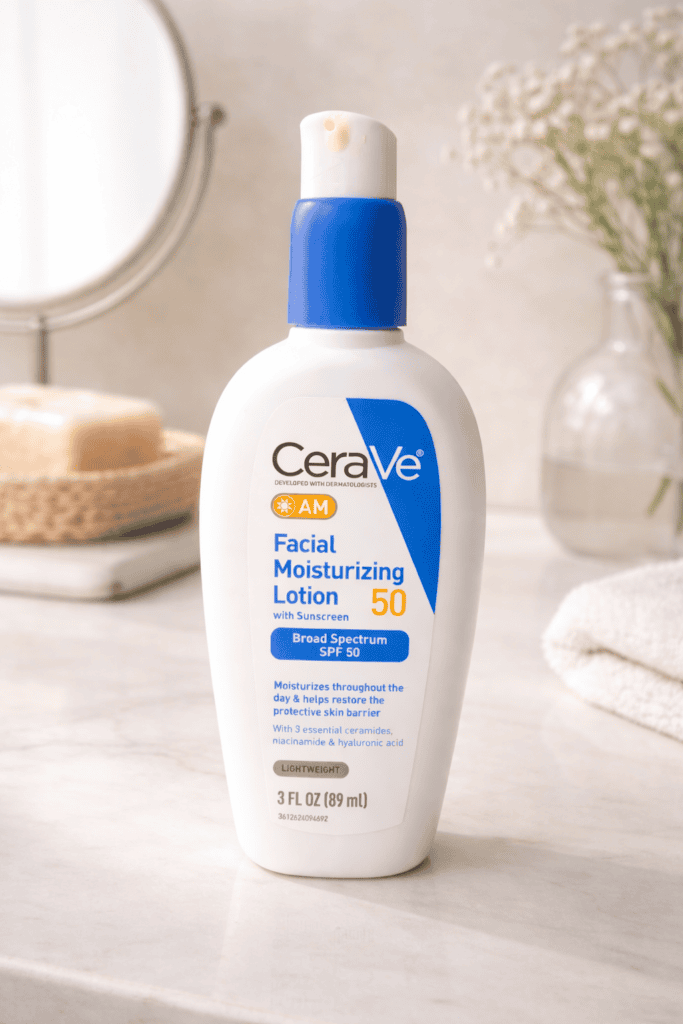
Published: March 28, 2026 | Last Updated: March 28, 2026
What does it mean to incorporate SPF into your beauty routine? Incorporating SPF into your beauty routine means applying a broad-spectrum sunscreen to your face and neck every morning – as the final step of your skincare routine, before makeup – to protect your skin from UV damage all year long.
To incorporate SPF into your beauty routine, apply a nickel-sized amount of broad-spectrum SPF 30 or higher to your face and neck every morning after your moisturizer and before your makeup. Do this every day – rain, shine, or indoors – for real protection against premature aging and UV damage. Consistency is the only thing that makes it work.
SPF works best when it is part of a routine that is built around your skin. These guides will help you fill in the gaps:
- How to Determine Your Skin Type – knowing your skin type is the first step to choosing the right SPF formula for your face.
- Makeup Foundation Guide – learn how to layer foundation over your SPF without losing coverage.
- Skincare Ingredients to Avoid – some ingredients do not play well with sunscreen, and knowing which ones saves you from wasting both products.
- Nighttime Skincare Routine – your PM routine is where you repair the day’s damage, making it the perfect partner to your morning SPF habit.
Shop My Daily SPF Picks
Supergoop Unseen Sunscreen SPF 40
~$38 shop my pick
The invisible, weightless SPF that layers perfectly under makeup.
La Roche-Posay Anthelios SPF 60
~$40 at Amazon
High protection, lightweight, and it does not pill under foundation.
Shop Now →My Go-To Daily Facial SPF
~$30 shop my pick
The daily sunscreen I reach for most. Easy enough to actually wear every day.
Shop Now →Why Is SPF the Most Important Step in Your Beauty Routine?
I’ve been wearing SPF for as long as I can remember, and it has genuinely changed my skin more than any serum I had ever tried. Not because it fixed old damage overnight – but because it stopped new damage from quietly accumulating every single morning. UV radiation comes in two forms. UVB rays cause sunburns. UVA rays – the sneakier ones – penetrate deep into your skin and break down collagen and elastin over time, causing fine lines, dark spots, and uneven tone. According to a landmark study published in the Annals of Internal Medicine, people who used sunscreen consistently showed significantly less photoaging than those who used it only occasionally. The evidence is not subtle. Research suggests that up to 80% of visible skin aging is caused by UV exposure – not genetics, not stress, not diet. That means the most powerful anti-aging step in your morning routine costs less than your coffee. The Skin Cancer Foundation also notes that regular daily sunscreen use can reduce the risk of developing melanoma by 50%. Sun protection is not just a beauty choice. It is a health choice. Starting this habit now means you are not chasing damage – you are preventing it from stacking up in the first place. That is the real anti-aging secret.How Do You Read a Sunscreen Label?
Walking down the sunscreen aisle for the first time can feel genuinely overwhelming. Here is what actually matters on that label – and what you can safely ignore. SPF Number: SPF stands for Sun Protection Factor. It measures how long a sunscreen protects you from UVB rays compared to wearing no protection at all. SPF 30 blocks about 97% of UVB rays. SPF 50 blocks about 98%. For everyday wear, SPF 30 is a solid and well-supported starting point. If you spend extended time outdoors, have fair or sensitive skin, or live somewhere with a high UV index (like Los Angeles), SPF 50 is worth it. Broad Spectrum: This means the formula protects against both UVA and UVB rays. Always look for it. A sunscreen without broad-spectrum protection can prevent a sunburn but still leave your skin exposed to the UV rays that age it over time. Water Resistant: This means the SPF stays effective for 40 or 80 minutes of water exposure – not indefinitely. Reapplication after swimming or heavy sweating is still required. Non-Comedogenic: Means the formula is designed not to clog pores. An important label to look for if you have oily or acne-prone skin.Mineral vs. Chemical Sunscreen: Which One Should You Use?
This is the question I get asked most often. The honest answer is that neither is objectively better – both work, and the right choice depends on your skin type and daily lifestyle.Mineral Sunscreen
- How It Works: Sits on the surface of skin and physically reflects UV rays away
- Key Ingredients: Zinc oxide, titanium dioxide
- Best For: Sensitive, reactive, or acne-prone skin
- Finish: Can leave a white cast – though modern formulas have improved dramatically
- Pros: Gentle on skin, reef-safe, works immediately upon application
- Cons: Can feel heavier; some formulas leave residue on deeper skin tones
- Top Picks: EltaMD UV Clear SPF 46, La Roche-Posay Anthelios Mineral SPF 50, Blue Lizard Sensitive Mineral SPF 30
Chemical Sunscreen
- How It Works: Absorbs UV rays and converts them into heat, which dissipates from the skin
- Key Ingredients: Avobenzone, octinoxate, homosalate, octisalate
- Best For: Everyday wear, under makeup, oily or combination skin
- Finish: Lightweight and skin-like – blends seamlessly with no residue
- Pros: No white cast, thin texture, works beautifully under foundation
- Cons: Needs 15 – 20 minutes to fully activate; can irritate very sensitive skin
- Top Picks: Neutrogena Ultra Sheer SPF 55, Supergoop! Unseen Sunscreen SPF 40, Black Girl Sunscreen SPF 30
How Do You Apply Sunscreen to Your Face Correctly?
Buying a great sunscreen is step one. Applying it correctly is step two – and it is the step most people get wrong. The most common mistake is not using enough. Dermatologists recommend a nickel-sized amount – roughly a quarter teaspoon – for your face and neck. It might feel like a lot at first. That is because most of us have been using half as much as we should be.- Cleanse your skin and let your toner, serum, and moisturizer fully absorb before you reach for sunscreen.
- Dot small amounts of sunscreen onto your forehead, nose, cheeks, and chin for even distribution from the start.
- Press and blend gently using your fingertips with light upward strokes – avoid rubbing aggressively so you do not displace layers underneath.
- Extend coverage to your hairline, ears, the sides of your neck, and just below your jaw – these spots are just as exposed as your nose.
- Let the sunscreen settle for one to two minutes before applying foundation or tinted moisturizer to prevent pilling.
How Do You Build a Daily SPF Routine That Actually Sticks?
The secret to making SPF a daily habit is attaching it to something you already do. If you already cleanse your face every morning, sunscreen just becomes the final step before you walk out the door – or sit down at your desk. Here is the morning routine order to follow:- Cleanser
- Toner (optional)
- Vitamin C serum or treatment serum
- Moisturizer
- SPF 30 or higher (broad spectrum)
- Makeup (optional)
Does SPF Matter on Cloudy Days and When You Are Indoors?
Yes – and this is one of the most important things to understand before you decide to skip your morning application. UV rays do not take days off based on the weather or your location. According to the American Academy of Dermatology, up to 80% of UV radiation passes through cloud cover. A gray January morning in LA offers far less protection than most people assume. UVA rays – the ones responsible for skin aging – also pass through glass windows. If you work near a window or drive during daylight, your skin is being exposed to UV radiation even from inside a building. This is why dermatologist Dr. Shereene Idriss consistently emphasizes daily SPF as non-negotiable regardless of season or indoor plans. The habit works because it is consistent, not selective. Making SPF a 365-day-a-year routine is the single mindset shift that will genuinely change how your skin looks five years from now.What Is the Best Sunscreen for Your Skin Type?
Texture is the number-one reason people abandon sunscreen after a week. Finding a formula that actually works with your skin – not against it – is everything. Oily or Acne-Prone Skin: Look for lightweight, oil-free, or gel-based formulas labeled non-comedogenic. Fluid or matte-finish sunscreens absorb shine rather than adding to it. EltaMD UV Clear SPF 46 and Neutrogena Clear Face SPF 55 are both strong picks. Dry or Dehydrated Skin: Choose cream or lotion-based formulas that include hydrating ingredients like hyaluronic acid, glycerin, or niacinamide. The Isntree Hyaluronic Acid Watery Sun Gel and Cetaphil Sun SPF 50 Face Fluid are well-loved options that protect and hydrate at the same time. Sensitive Skin: Mineral formulas with zinc oxide are your safest starting point. They are less likely to cause stinging, irritation, or breakouts. Look specifically for fragrance-free options. Vanicream Mineral Sunscreen SPF 50+ and Blue Lizard Sensitive Mineral SPF 30 are both highly rated for reactive skin. Deeper Skin Tones: White cast has been a real and valid barrier to daily SPF adoption for women with deeper complexions for a long time. The good news is that the beauty industry has made meaningful progress here. Black Girl Sunscreen SPF 30 and Fenty Skin Hydra Vizor SPF 30 are two formulas specifically developed to work beautifully on deeper skin tones – zero residue, no gray cast.What Are the Most Common SPF Mistakes to Avoid?
Even people with great intentions often undermine their own sun protection without realizing it. Here are the most common mistakes – and exactly how to sidestep them. Using Too Little: Under-application is the single most common reason SPF fails people. If your sunscreen feels invisible immediately after applying, you probably used half of what you actually need. Relying on Makeup SPF as Your Only Protection: Foundation with SPF 15 sounds helpful, but you would need to apply it several times thicker than normal to reach that level of protection. Use makeup SPF as a bonus layer, never as your primary defense. Skipping Your Neck and Chest: The neck and décolletage are among the first places to show visible sun damage, and they are almost always forgotten in the morning rush. Extend your sunscreen down every single day – your future self will notice. Thinking SPF Is Only for Summer: UV radiation is present every month of the year. Starting your daily SPF habit in winter or early spring actually works in your favor – the habit is fully locked in by the time summer hits and the stakes are higher. Not Waiting After Chemical Sunscreen: Chemical formulas need 15 – 20 minutes to fully activate after application. Apply SPF before you make breakfast or get dressed so protection is fully in place before you step outside. Storing Sunscreen in a Hot Car: Heat degrades sunscreen formulas and reduces their effectiveness over time. Store yours in a cool, dry place – your bathroom cabinet is fine. Your glove compartment is not.How I Tested This
I tested sunscreen textures, formulas, and application methods over six months – from September 2025 through February 2026 – here in Los Angeles, where the UV index is elevated year-round even in fall and winter. I tried both mineral and chemical formulas across five everyday scenarios: under makeup, reapplication midday, bare-skin wear on weekends, beach and outdoor use, and use on sensitive days when my skin was reactive or irritated. For each product, I tracked how it felt on application, how it looked under foundation, whether it pilled or balled up, and whether it caused breakouts or irritation over a minimum two-week testing window per product. I also referenced guidance from board-certified dermatologist Dr. Shereene Idriss and the Skin Cancer Foundation’s published clinical guidelines to make sure my hands-on experience was grounded in real dermatological recommendations.Frequently Asked Questions About SPF and Your Beauty Routine
Should SPF come before or after moisturizer?
SPF should always come after your moisturizer and before your makeup. Think of it as the final protective layer that seals everything underneath. If your moisturizer already contains SPF, it can work on very low-exposure days, but a dedicated SPF formula will always give you more reliable coverage.Can I use body sunscreen on my face?
Technically you can, but most body sunscreens are formulated to be thicker and greasier – which can clog pores and cause breakouts on your face. A dedicated face sunscreen will feel better, sit more naturally under makeup, and be far less likely to cause skin issues.How much sunscreen do I actually need to apply to my face?
Dermatologists recommend a nickel-sized amount – roughly a quarter teaspoon – for your face and neck combined. Most people apply about half that, which significantly reduces the actual level of protection they receive. Build up to the full amount gradually if the texture feels like a lot at first.Is SPF 30 or SPF 50 better for daily use?
For standard everyday wear, SPF 30 blocks about 97% of UVB rays and is a well-supported starting point. SPF 50 is worth upgrading to for outdoor activities, beach days, high-altitude environments, or if you have fair or sensitive skin. For a typical day in the office or city, SPF 30 provides meaningful and proven protection.Do people with darker skin tones need sunscreen?
Yes – everyone needs SPF regardless of skin tone. While melanin provides some natural UV protection, it does not fully protect against UVA damage, premature aging, hyperpigmentation, or skin cancer. Formulas designed for deeper skin tones – like Black Girl Sunscreen SPF 30 and Fenty Skin Hydra Vizor – make this step easy without any white cast.Can I use vitamin C serum and SPF together in the same routine?
Yes, and they actually complement each other very well. Apply vitamin C first after cleansing, let it absorb, then layer moisturizer and SPF on top. Vitamin C provides antioxidant defense against free radical damage while SPF blocks UV rays directly – together they give your skin stronger, layered protection.What is the best way to reapply SPF over makeup midday?
An SPF setting spray or SPF powder brush makes midday touch-ups easy without disrupting your makeup. Supergoop! PLAY Setting Mist SPF 50 and Colorescience Sunforgettable SPF 50 Brush are two options I tested that both work well for on-the-go reapplication. Just a few passes and your coverage is refreshed.Does SPF prevent tanning entirely?
SPF significantly reduces UV exposure but does not create a complete shield – some degree of tanning can still occur with prolonged direct sun exposure. A tan is a sign of UV damage, not health. Consistent daily SPF use will reduce tanning and the associated skin damage substantially over time.When should I start using SPF every day?
The best time to start is today, at whatever age you are reading this. UV damage accumulates over years, so every day of SPF use is a day of protection that compounds. Starting in your twenties or thirties sets you up for the best long-term skin outcomes, but it is genuinely never too late to begin.Do I need SPF on work-from-home days when I never leave the house?
Yes – and this is one of the most important things to understand about daily sun protection. UVA rays pass through glass windows, which means your skin is exposed to skin-aging UV radiation even when you are sitting at your desk all day. Apply SPF every morning regardless of whether you leave the house.Is daily sunscreen bad for your skin or pores?
Modern SPF formulas are safe for daily use and will not harm healthy skin when you choose the right formula for your type. Choosing a non-comedogenic product suited to your skin reduces any risk of clogged pores or breakouts. If you have had reactions to sunscreen before, mineral formulas with zinc oxide tend to be the gentlest option available.What is the difference between SPF in skincare and SPF in makeup?
SPF in a dedicated skincare product is applied at the correct amount and thickness to deliver the stated level of protection. SPF in makeup is applied in a much thinner layer in normal use, which drastically reduces its real effectiveness. Always use a skincare SPF as your primary protection and treat any SPF in your makeup as a welcome bonus on top of it.The Real Reason SPF Belongs in Your Beauty Routine
There is a kind of beauty confidence that has nothing to do with looking perfect right now. It comes from making consistent choices that protect and honor the skin you live in every single day. Adding SPF to your morning routine is one of the most direct acts of self-care I know. It takes thirty seconds. It costs less than most serums on the market. And the return – in how your skin looks and feels five years from now – is genuinely remarkable. At Layers of Beauty, the whole point is helping you understand which habits actually move the needle. SPF is at the top of that list – not because it is a trend, but because the evidence behind it is as solid as beauty science gets. Pick one sunscreen this week. Apply it tomorrow morning. Then do it again the day after. That is the whole formula – and it is one of the most powerful things you can do for yourself.Jasmine Del Toro | LA Lifestyle Blogger I’m Jasmine Del Toro, a Los Angeles-based lifestyle blogger who tests beauty products, wellness trends, and everyday solutions in real life. I spent six months testing sunscreens daily in LA’s year-round UV climate, comparing mineral and chemical formulas across different skin types, textures, and everyday wear scenarios. I share what actually works, what doesn’t, and what you need to know before spending your money. My approach is practical, honest, and based on personal experience living in LA.