
Published: May 15, 2026 | Last Updated: May 15, 2026
Which Under-Eye Creams Actually Work?
The under-eye area tells on you before anything else does. One late night, one salty dinner, one allergy flare – and suddenly you look exhausted even after eight hours of sleep. I've tested eye creams obsessively for years because puffiness, dark circles, and fine lines are all real concerns for me, especially living in LA where late nights are part of the deal.
The honest truth is that most eye creams do nothing. They're overpriced moisturizers in tiny jars marketed to your most anxious insecurities. But after testing dozens of formulas, I've found five that hold up to scrutiny – and I'm breaking them down here so you don't waste money the way I did.
Eye cream works best as part of a layered routine – my morning skincare routine covers where eye cream fits in the AM sequence, and the nighttime skincare routine shows how I use heavier formulas before sleep. The Rhode eye patches review covers a targeted add-on that genuinely delivers for morning puffiness, and my guide to skincare ingredients to avoid explains why certain preservatives in eye creams cause more irritation than they're worth. If you're not sure what your skin needs, figuring out your skin type first helps you narrow down which formula to start with.
What Is Under-Eye Cream?
Under-eye cream is a targeted skincare product formulated specifically for the thin, fragile skin around the eye area, which behaves differently from the rest of your face. It matters because the skin under your eyes is about 0.5mm thick – compared to 2mm on the rest of your face – and it has almost no oil glands, making it more prone to dryness, fine lines, and puffiness. Eye creams are most useful for people dealing with persistent puffiness, dark circles, fine lines, or under-eye dryness that a regular moisturizer doesn't address.
Quick Answer
The best under-eye creams are CeraVe Eye Repair Cream for sensitive skin and beginners ($14), Ole Henriksen Banana Bright+ for dark circles and puffiness ($39), and Kiehl's Creamy Eye Treatment for overnight dryness and fine lines ($35). Apply with your ring finger by tapping – never rubbing – along the orbital bone morning and night.
Quick Takeaways
- Most eye creams do nothing – ingredients are what matter, not price
- Dark circles are mostly genetic – no cream fully fixes structural causes
- Caffeine reduces puffiness fast; retinol builds collagen slowly
- Always tap with your ring finger – rubbing causes damage to thin eye skin
- Apply too close to the lash line and you'll get milia
- Give retinol-based eye creams 8–12 weeks before judging results
Table of Contents
- What Actually Causes Under-Eye Issues?
- What Are the Best Under-Eye Creams Right Now?
- What Ingredients in Eye Cream Actually Work?
- How Do You Apply Eye Cream Correctly?
- What Under-Eye Cream Mistakes Are You Making?
- How Do the Best Eye Creams Compare?
- How I Tested These Eye Creams
- Pros and Cons
- Frequently Asked Questions
Cooling gel patches for puffy mornings. Peptides and CoQ10 firm while they de-puff.
Shop Now →Caffeine and collagen patches at a great cost per pair. My go-to before makeup.
Shop Now →The viral budget hydrogel masks. Under $10 and genuinely effective for hydration.
Shop Now →What Actually Causes Under-Eye Issues?
Before spending a dollar on eye cream, it helps to understand what you're actually dealing with. Most people lump dark circles, puffiness, and fine lines into one problem – but they have completely different causes and completely different solutions.
Dark circles are almost always genetic. Either you have naturally more melanin in that area, or your skin is thin enough that blood vessels underneath show through as a bluish or purplish shadow. Tiredness makes it worse, but if you've had dark circles since your twenties regardless of sleep, that's your answer – no caffeine cream alone will fix structural causes.
Puffiness is a fluid retention issue. Salt, alcohol, sleeping face-down, and seasonal allergies all cause lymphatic fluid to pool under your eyes overnight. It usually resolves by mid-morning on its own, but the right ingredients – specifically caffeine – can speed that process up significantly.
Fine lines form because the under-eye skin is uniquely fragile. At roughly 0.5mm thick with almost no oil glands, it's the first area to show collagen loss. Retinol and peptides both target this specifically and have the most clinical evidence behind them for this concern.
Knowing which concern is primary for you is the most useful thing you can do before shopping. No single eye cream fixes all three perfectly, and buying for the wrong concern is how people end up disappointed with otherwise good products.
What Are the Best Under-Eye Creams Right Now?
These are the five I've personally tested and can recommend based on real results. They cover every price point and every main under-eye concern.
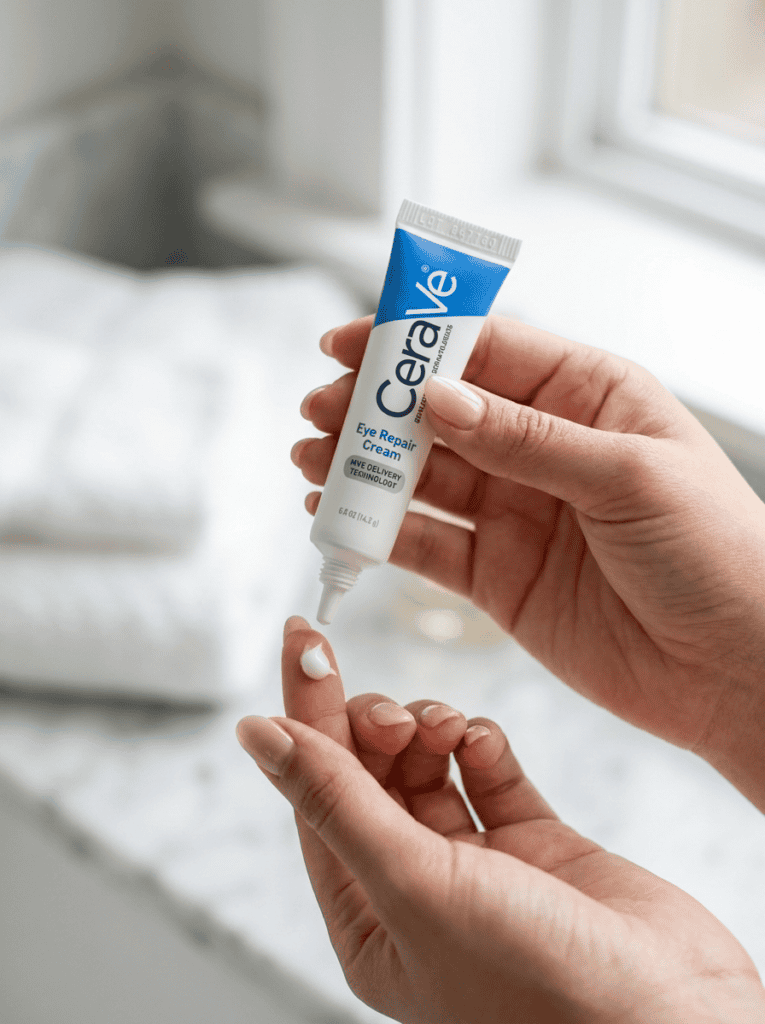
CeraVe Eye Repair Cream – Best for Sensitive Skin (~$14)
This is the first recommendation for anyone who has never used an eye cream before, or anyone with reactive skin that can't tolerate fragrance or actives. The ceramides, niacinamide, and hyaluronic acid combination quietly keeps under-eyes healthy, hydrated, and calmer over time without any irritation risk. It won't perform miracles, but it builds a strong foundation. Shop on Amazon.
Ole Henriksen Banana Bright+ Eye Crème – Best for Dark Circles (~$39)
If dark circles and dullness are your main complaint, this one addresses them more directly than anything else I've tested at this price point. The vitamin C complex brightens over time while caffeine delivers an immediate tightening effect that makes mornings look more manageable. It's lightweight enough to sit perfectly under SPF and makeup without pilling. Shop on Amazon.
Kiehl's Creamy Eye Treatment with Avocado – Best for Dryness (~$35)
This is the eye cream I've repurchased more times than I can count and reach for whenever my under-eyes feel tight or crepey. The texture is genuinely rich – almost balm-like – which does wonders for dryness and smoothing fine lines overnight. I wouldn't use it in the morning under foundation since it's heavy enough to pill if it hasn't fully absorbed, but as an overnight treatment it's exceptional. Shop on Amazon.
Neutrogena Rapid Wrinkle Repair Eye Cream – Best Budget Retinol (~$20)
This is my go-to for anyone who wants real anti-aging results without spending $80. The retinol concentration is meaningful enough to stimulate collagen over time, and the hyaluronic acid prevents the formula from feeling stripping or harsh. Commit to at least eight weeks before expecting visible results – but once they arrive, they're consistent. Night use only due to retinol. Shop on Amazon.
Peter Thomas Roth Instant FIRMx Eye – Best Instant Fix (~$50)
This isn't a traditional eye cream – it's a targeted treatment for when you need to look awake immediately. The silica tightens and smooths within minutes, and the effect is impressive for photos, events, or mornings when you got four hours of sleep. It's not a substitute for daily eye care, but as a prep step before something important, nothing I've tested comes close to its speed. Shop on Amazon.
What Ingredients in Eye Cream Actually Work?
Caffeine is the most reliable ingredient for immediate puffiness reduction. It works by constricting blood vessels and encouraging lymphatic drainage, reducing puffiness noticeably within about 20 minutes of application. The effect is temporary – it doesn't fix the underlying fluid retention – but for morning use it's one of the most consistent actives available.
Retinol is the gold standard for fine lines. It's one of the few ingredients with clinical proof of stimulating collagen production over time. Use it at night only – it breaks down in sunlight and the under-eye skin is more sensitive than the rest of your face, so start with the lowest available concentration.
Vitamin C and niacinamide both target pigmentation-based dark circles by interfering with melanin production. Vitamin C is more potent but less stable. Niacinamide is gentler and pairs with almost anything in a routine.
Peptides signal the skin to produce more collagen without retinol's irritation risk, making them the smart long-term choice for anyone who can't tolerate retinol around the eyes. Hyaluronic acid plumps fine lines temporarily and prevents the under-eye area from looking crepey or dehydrated throughout the day.
According to the American Academy of Dermatology, retinoids remain among the most evidence-backed topical ingredients for reducing the appearance of fine lines – including the delicate under-eye area when applied carefully.
How Do You Apply Eye Cream Correctly?
Application matters more than most people realize, and doing it wrong can create new problems. The most important rule: always use your ring finger. It applies the least pressure of any finger, which matters when the skin you're touching is only half a millimeter thick.
- Dispense a pea-sized amount (per eye) onto your ring fingertip.
- Dot small amounts along the orbital bone – the bony ridge just below your eye socket.
- Tap gently to blend – never rub or drag the skin.
- Keep the product a few millimeters away from your lash line – it migrates inward naturally.
- In the morning, let it absorb for 60 seconds before applying SPF or makeup on top.
- At night, apply after serums but before any heavier face oil or sleeping mask.
Applying too close to the lash line is one of the most common mistakes, and it causes milia – tiny hard white bumps under the skin that form when product migrates into follicles. A few millimeters of clearance and letting the formula migrate naturally prevents this entirely.
What Under-Eye Cream Mistakes Are You Making?
Using too much product. A pea-sized amount per eye is the right amount. Using more doesn't improve results – it causes pilling under makeup and increases the risk of milia. Less is genuinely more with eye cream.
Expecting results in two weeks from retinol-based creams. Retinol builds collagen slowly. The meaningful results from Neutrogena Rapid Wrinkle Repair or any retinol eye cream come at 8–12 weeks of consistent nightly use. Quitting after two weeks and concluding it doesn't work is the most common reason people miss out on real collagen-building progress.
Rubbing instead of tapping. Rubbing drags the skin and over time contributes to both fine lines and puffiness by damaging the thin tissue. Tap only, always, with the ring finger. It's a different motion than you're used to for most skincare application but it becomes automatic quickly.
Using a heavy nighttime formula in the morning. Rich formulas like Kiehl's Creamy Eye Treatment take time to absorb. Applying them right before SPF and foundation means they haven't set, which causes pilling and uneven coverage under the eye. Either use a lighter formula in the morning or apply your eye cream first and wait two to three minutes before any other products.
How Do the Best Under-Eye Creams Compare?
CeraVe Eye Repair Cream
- Price: ~$14
- Best For: Sensitive skin, beginners, barrier repair
- Key Ingredients: Ceramides, niacinamide, hyaluronic acid
- Texture: Medium cream – AM or PM, non-greasy
- Irritation Risk: Very low – fragrance-free
- Results Timeline: 4–6 weeks for hydration improvement
Ole Henriksen Banana Bright+ Eye Crème
- Price: ~$39
- Best For: Dark circles, morning puffiness, dullness
- Key Ingredients: Vitamin C, caffeine, banana powder
- Texture: Lightweight – excellent under SPF and makeup
- Irritation Risk: Low to moderate
- Results Timeline: Immediate (caffeine); 6–8 weeks for brightening
Kiehl's Creamy Eye Treatment
- Price: ~$35
- Best For: Dryness, fine lines, overnight repair
- Key Ingredients: Avocado oil, beta-carotene, shea butter
- Texture: Rich balm – best as PM formula
- Irritation Risk: Low
- Results Timeline: 4–8 weeks of nightly use
Neutrogena Rapid Wrinkle Repair Eye
- Price: ~$20
- Best For: Fine lines, long-term collagen support
- Key Ingredients: Retinol, hyaluronic acid
- Texture: Light-to-medium – night use only
- Irritation Risk: Moderate – retinol can sensitize
- Results Timeline: 8–12 weeks minimum
Peter Thomas Roth Instant FIRMx Eye
- Price: ~$50
- Best For: Instant tightening before events or photos
- Key Ingredients: Silica, sodium silicate, oat extract
- Texture: Thin serum – dries to barely-there film
- Irritation Risk: Low
- Results Timeline: Immediate – temporary effect only
How I Tested These Eye Creams
I've been consistently using eye cream since my mid-twenties, when dark circles and morning puffiness became a regular enough problem that I started taking it seriously. My testing approach: a minimum eight-week trial for each product, applied consistently morning and/or night as intended, with before-and-after photos taken in the same lighting every four weeks.
I test on myself but also track feedback from friends with different skin concerns. One friend with very sensitive skin and no dark circles tested the CeraVe and Kiehl's specifically for dryness and texture – her notes informed how I describe those formulas. As of May 2026, all five products in this guide are ones I actively use or have used within the past year.
I also made application mistakes during testing – particularly over-applying the Kiehl's formula in the morning before foundation, which taught me the pilling issue firsthand. These practical details matter more than ingredient lists when you're actually building a routine, and they're why I included the application section rather than just a product roundup.
Pros and Cons of Using Under-Eye Cream
What Works in Your Favor
- Targeted results: Specific ingredients address what face moisturizer can't
- Consistent long-term use pays off: Retinol and peptides build real collagen over time
- Accessible price points: CeraVe at $14 and Neutrogena at $20 are genuinely effective
- Preventative value: Starting in your twenties or early thirties slows visible aging significantly
- Sensitive-skin options: Fragrance-free formulas work for even reactive skin types
What to Know Going In
- Dark circles have limits: No cream fixes structural or genetic dark circles fully
- Milia risk: Wrong application or too much product near the lash line causes bumps
- Retinol requires patience: 8–12 weeks before meaningful fine line improvement
- Instant-fix products are temporary: Silica tighteners wear off and don't treat underlying skin
Frequently Asked Questions
Do under-eye creams actually work?
Some do, most don't. The ones that work contain ingredients with real evidence behind them – caffeine for puffiness, retinol for fine lines, vitamin C and niacinamide for dark circles. The ones that don't are basic moisturizers in small jars at inflated prices. Focus on the ingredient list, not the brand or the packaging.
When should you start using eye cream?
Your mid-to-late twenties is a reasonable starting point. The skin around your eyes starts losing collagen in your twenties, so establishing a hydrating and protective routine before visible lines appear is genuinely preventative. That said, it's never too late to start – consistent use at any age produces results.
How long does it take for eye cream to work?
Caffeine-based creams work within 20 minutes of application for puffiness. Brightening effects from vitamin C and niacinamide take six to eight weeks. Retinol-based collagen building takes eight to twelve weeks of consistent nightly use before visible fine line improvement appears.
Should you use eye cream in the morning or at night?
Most eye creams work well both AM and PM. Lightweight caffeine formulas are best in the morning for puffiness and dark circles. Rich or retinol-based formulas are better at night when you don't need to layer makeup over them. Many people use a lighter formula in the morning and a more intensive one at night.
Can eye cream cause milia?
Yes – if you apply it too close to the lash line or use too much. Milia are tiny hard white bumps that form when product migrates into follicles. Always keep eye cream a few millimeters back from the lash line and use only a pea-sized amount per eye. The product migrates naturally with body heat.
What is the best ingredient for dark circles?
Vitamin C and niacinamide both target pigmentation-based dark circles by interfering with melanin production. Vitamin C is more potent but less stable. Niacinamide is gentler and pairs with everything. For vascular dark circles (blue or purple tone), caffeine can temporarily reduce the visibility by constricting underlying blood vessels.
What is the best ingredient for puffy eyes?
Caffeine is the most effective topical ingredient for reducing morning puffiness. It constricts blood vessels and promotes lymphatic drainage, visibly reducing swelling within about 20 minutes. Cold compresses, sleeping at a slight incline, and reducing sodium intake the night before also help significantly.
Can you use retinol under your eyes?
Yes, but carefully. The skin under your eyes is more sensitive than the rest of your face, so start with a very low concentration and use it every other night rather than nightly until your skin adjusts. Apply after your regular eye cream to buffer the retinol slightly, and never apply it right up to the lash line.
Is expensive eye cream worth it?
Not automatically. CeraVe at $14 outperforms many $80 options because it has the right ingredients and a fragrance-free formula. Where higher-priced eye creams earn their cost is in delivery systems and specific formulations – SkinCeuticals and some peptide-heavy formulas have clinical evidence behind specific concentrations. If you want to explore a premium option with strong clinical backing, the Dermalogica Phyto Nature Oxygen Eye Cream — full review breaks down whether it earns its price tag. Spend more only when the ingredient list justifies it.
What is the difference between eye cream and regular moisturizer?
A good eye cream is specifically formulated for the thinner, more fragile skin around the eyes – lower fragrance levels, gentler surfactants, and specific actives like caffeine or peptides that address eye-area concerns. Many face moisturizers are too heavy or too fragranced for the eye area and can cause irritation or milia. A dedicated eye cream is genuinely worth using separately.
Can you use too much eye cream?
Yes – a pea-sized amount per eye is all you need. Using more increases milia risk, causes pilling under makeup, and doesn't produce better results. If your eye cream is sitting on top of the skin rather than absorbing, you're using too much.
Why are my dark circles getting worse despite using eye cream?
If your dark circles are genetic or structural, no topical will fully eliminate them – it's important to set realistic expectations. Contributing factors that make genetic dark circles worse include dehydration, high sodium intake, alcohol, lack of sleep, and seasonal allergies. Addressing those alongside consistent eye cream use gives you the best combined result.
The Honest Takeaway on Under-Eye Creams
The eye area is one of the most over-marketed zones in beauty, and most of what's out there is priced on anxiety rather than results. The five options in this guide earn their spot because the ingredients actually match the claims – and the prices range from $14 to $50, so there's no excuse to overpay.
Understanding what your skin actually needs – whether that's barrier support, caffeine for puffiness, or long-term retinol commitment – is what separates routines that work from ones that drain your wallet. That clarity, not the most expensive product, is what actually shows up in your skin every morning. And that's what Layers of Beauty is here to give you.
Start with CeraVe Eye Repair Cream if you're new to eye cream – it's $14 and nearly impossible to react to. Once your skin is accustomed, layer in Ole Henriksen for brightening or Neutrogena for long-term collagen work. That two-step approach covers more ground than any single $80 eye cream.
You Might Also Like
Jasmine Del Toro | LA Lifestyle Blogger
I'm Jasmine Del Toro, a Los Angeles-based lifestyle blogger who tests beauty products, wellness trends, and everyday solutions in real life. I've been testing eye creams for over five years and have worked through dozens of formulas across every price point to find the ones that actually deliver on their claims. I share what actually works, what doesn't, and what you need to know before spending your money. My approach is practical, honest, and based on personal experience living in LA.