
Published November 12, 2026 · Last updated November 12, 2026
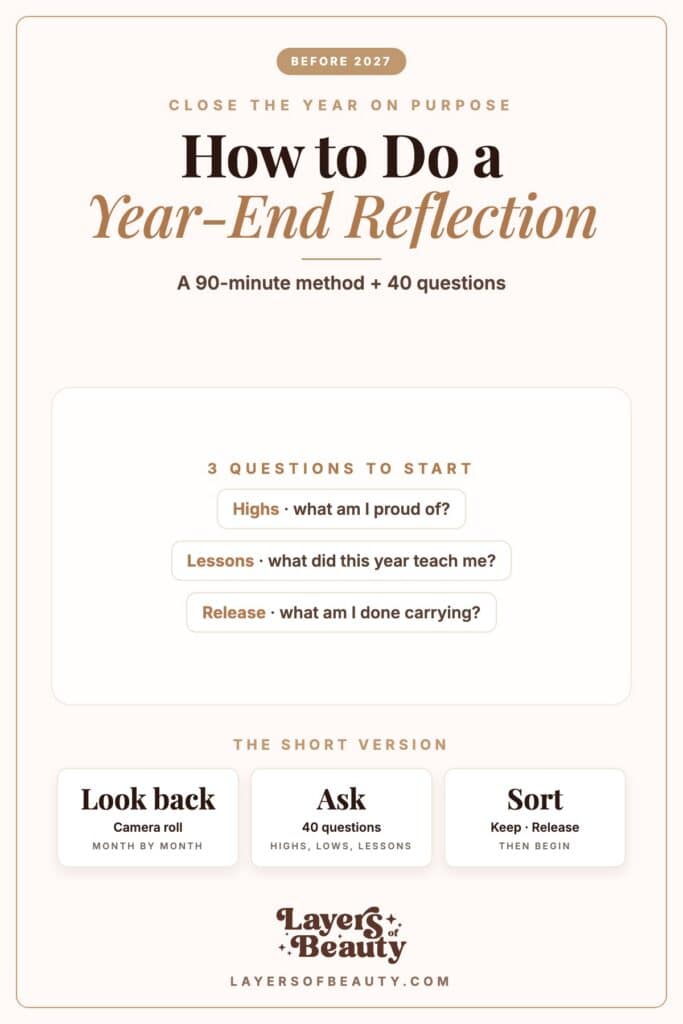
A year-end reflection is the easiest way to close one year on purpose before the next one starts. Instead of rushing into resolutions, you look back at what really happened, what it taught you and what you want to carry into 2027.
This guide gives you a 90-minute method, 40 year-end reflection questions, three simple templates and a way to turn what you learn into a short list of intentions. You only need a notebook, a quiet hour and your phone's camera roll.
If you are already thinking about next year, my practical guide to New Year goals is the natural next step after this one. If the year left you feeling flat, what I do when I feel stuck in life and how to reinvent yourself pair well with a reflection, and my guide to practicing self-love helps if the hard part is being kind to yourself.
What Is a Year-End Reflection?
A year-end reflection is a planned look back at the past twelve months, where you review what happened, what you learned and what you want to keep, release or begin next year. It matters because it turns a blur of busy months into clear lessons you can act on, instead of repeating the same year again. It is most useful for anyone who wants to set better goals, close a hard year with some peace or simply notice how much they have grown.
The Short Answer
To do a year-end reflection, block 60 to 90 minutes, gather your camera roll, calendar and notes, and write a month-by-month list of what happened. Then answer a set of reflection questions about your highs, lows, lessons and people, sort what you found into keep, release and begin, and pick one to three intentions for the new year.
Quick Takeaways
- Block 60 to 90 minutes somewhere quiet, with a notebook.
- Use evidence: your camera roll, calendar and notes app.
- Write a month-by-month timeline before you answer questions.
- Ask about highs, lows, lessons, people, health and money.
- Sort everything into keep, release and begin.
- End with gratitude and one to three intentions, not ten goals.
What This Guide Covers
What Is a Year-End Reflection and Why Does It Matter?
A year-end reflection is a planned review of your year, usually done in December, where you look at what happened, how you felt and what you learned. Unlike a resolution, it looks backward first. The point is to understand the year you had before you plan the one you want.
Most people skip this step. They jump from a busy December straight into a list of New Year goals, which is how the same goals end up on the list year after year.
Writing things down also helps your head. The University of Rochester Medical Center notes that journaling can help you manage anxiety, reduce stress and sort your problems and worries into a clear order. A year-end reflection is simply journaling with a focus: one year, one notebook, one sitting.
As of November 2026, this is a good time to plan your own year-end reflection. Picking a date now means it actually happens, instead of getting lost in holiday plans.
How Do You Do a Year-End Reflection, Step by Step?
To do a year-end reflection, follow eight steps: block time, gather evidence, write a monthly timeline, answer reflection questions, name the year, sort into keep, release and begin, choose one to three intentions and close with gratitude. The whole year-end review takes 60 to 90 minutes in one sitting.
- Block 60 to 90 minutes on your calendar and pick a quiet, cozy spot.
- Gather your evidence: camera roll, calendar, notes app and last year's goals.
- Write a month-by-month timeline of what happened, January to December.
- Answer the year-end reflection questions, one group at a time.
- Name the year with three words or a short chapter title.
- Sort what you found into three lists: keep, release and begin.
- Choose one to three intentions for the new year and one first step for each.
- Close with gratitude: write a thank-you note or a short gratitude list.
The evidence step is the one most guides skip, and it is the one that changes everything. Memory is unfair: it keeps the last two months and the worst week, and it forgets the small wins from March.
Scroll your camera roll month by month and jot one line for each month. Then do the same with your calendar. You will be surprised how much you did that you had already forgotten.
Keep the timeline simple. A line like "April: new job, first trip alone, hard month with sleep" is enough to jog your memory for the questions that come next.
What Questions Should You Ask in a Year-End Reflection?
The best year-end reflection questions cover eight areas: highs and wins, lows, lessons, people, health and self-care, work and money, letting go and looking ahead. You do not need to answer all 40 year-end reflection questions below. Pick the five or six in each group that make you pause.
Highs and wins
- What three moments from this year do I want to remember forever?
- What am I most proud of, even if nobody else noticed?
- What did I do for the first time?
- When did I feel most like myself?
- What was the best decision I made?
- What made me laugh the hardest?
Lows and hard parts
- What was the hardest moment of the year?
- What did I worry about that never happened?
- Where did I let myself down, and why?
- What drained my energy the most?
- What did I avoid that I knew I needed to face?
- What would I tell myself at the start of the year?
Lessons
- What is the biggest lesson this year taught me?
- What pattern kept showing up again and again?
- What do I know now that I did not know in January?
- What changed my mind?
- What did I learn about what I actually need?
- Which mistake taught me the most?
People and relationships
- Who showed up for me this year?
- Who did I grow closer to?
- Which relationships felt draining or one-sided?
- Who do I want to thank?
- Did I ask for help when I needed it?
- Who do I want to spend more time with next year?
Health, body and self-care
- How did I treat my body this year?
- Which habits made me feel good, and which ones did not?
- How was my sleep, most of the time?
- What self-care actually worked, and what was just shopping?
- When did I feel most confident in my own skin?
Work and money
- What work am I proud of this year?
- What did I spend money on that was truly worth it?
- What did I spend money on that I regret?
- Did my time match my priorities?
- What skill did I build?
Letting go
- What am I ready to stop carrying into next year?
- What do I need to forgive, in myself or someone else?
- What goal can I officially let go of?
Looking ahead
- What do I want more of next year?
- What do I want less of next year?
- How do I want to feel this time next December?
Write in full sentences when a question hits a nerve, and in quick bullets when it does not. The questions that make you uncomfortable are usually the ones with the most useful answers.
If one question sends you into a spiral, stop and write the facts only. My guide to stop overthinking has quick ways to get out of your head when a reflection turns into a replay.
What Is a Simple Year-End Reflection Template?
Three year-end reflection templates work for almost everyone: keep, release, begin; a month-by-month review; and the year as a chapter. Pick the one that matches your energy. A short template you finish beats a long one you quit halfway.
Keep, Release, Begin
- How it works: three lists, one page
- Time: about 20 minutes
- Best for: a fast, clear reset
- Output: habits and people to keep, things to drop, things to start
Month-by-Month Review
- How it works: one line per month, then patterns
- Time: 30 to 45 minutes
- Best for: a busy or blurry year
- Output: a timeline and the themes hiding in it
The Year as a Chapter
- How it works: title the year, then write a short story of it
- Time: 30 minutes
- Best for: a big year of change
- Output: a title, three words and one sentence of meaning
Keep, release, begin is the fastest. Draw three columns and fill them with habits, people, places and beliefs. Keep what helped, release what drained you and begin what you kept saying "one day" to.
The month-by-month review is best when the year feels like a blur. Write one line per month, then circle anything that shows up three or more times. Those repeats are your real themes.
The year as a chapter is the most emotional. Give the year a title, like "The Year I Started Over", pick three words for it and write one sentence about what it meant.
When Is the Best Time to Do a Year-End Reflection?
The best time for a year-end reflection is the last two weeks of December, especially the quiet days between Christmas and New Year's Eve. Any time from late November to early January works. What matters most is putting it on your calendar so it does not get pushed aside.
Some people prefer a birthday reflection instead, since it marks their own personal year. Others do a short check-in every season and a longer one in December.
If you are spending part of the holidays on your own, a reflection makes a lovely solo ritual. My guide to being happy alone during the holidays has more ideas for building a quiet day you actually enjoy.
Make it feel like an event. Pick a coffee shop, light a candle, make a playlist or bring a nice pen. Small details tell your brain this hour is special.
How Do You Write a Year-End Reflection for Work?
A year-end reflection for work looks at your wins, the skills you built, the feedback you got and what you want to change in your job next year. Write it down before your annual review, so you walk in with clear examples instead of trying to remember them on the spot.
Use these prompts for a work year-end review:
- What are my three biggest wins, with numbers if I have them?
- What skill did I build, and where did I use it?
- What feedback did I get, and what did I do with it?
- What part of my job gave me energy, and what drained it?
- What do I want more responsibility for next year?
Save your answers in a running "wins" note. It makes your next review, raise talk or resume update much easier.
How Do You Do a Year-End Reflection With a Partner or Friends?
To do a year-end reflection with a partner or friends, each person answers the same five or six questions on their own first, then you share answers over dinner or a walk. Doing it together builds closeness and gives you shared goals for the year ahead.
Good questions to share:
- What was our best moment together this year?
- When did you feel most supported by me?
- What is one thing we should do more of next year?
- What trip, tradition or date do we want to plan?
- What is one thing you are proud of me for?
Keep it light and kind. A year-end reflection with a partner is not the time to bring up every old fight. Save hard talks for a separate, calmer day.
Is a Year-End Reflection Better Than New Year's Resolutions?
A year-end reflection looks back at what really happened, while a New Year's resolution only looks forward at what you want to change. The reflection comes first, because it shows which goals actually matter. Resolutions made without a reflection often repeat last year's list.
Year-End Reflection
- Direction: looks back first
- Question: what happened and what did it teach me?
- Output: lessons, themes and gratitude
- Why it works: goals come from real evidence
New Year's Resolution
- Direction: looks forward only
- Question: what should I change?
- Output: a list of goals
- Where it fails: goals can repeat last year's list
Think of the reflection as the map and the resolutions as the route. You need to know where you are before you can plan where you are going.
How Do You Turn a Year-End Reflection Into Goals for 2027?
To turn a year-end reflection into goals, read your keep, release and begin lists and pick only one to three intentions for 2027. Give each one a clear first step you can take in the first week of January. Fewer goals with real first steps beat a long list you forget by February. If you want to start before January, my seven-week plan to reset your life before the new year spreads the work out.
Write each intention as a feeling plus an action. "I want to feel rested, so I will be in bed by 11 on weeknights" is easier to follow than "sleep more".
When you are ready to plan in detail, my New Year goals guide walks through setting goals that actually stick. How to build a routine that sticks helps you turn those intentions into daily habits.
End with gratitude. The National Institute of Mental Health lists practicing gratitude as one way to care for your mental health, and suggests reminding yourself daily of things you are grateful for.
A thank-you letter is a strong way to close your reflection. The Greater Good Science Center at UC Berkeley describes a study where people in counseling who wrote one gratitude letter a week for three weeks reported better mental health four and 12 weeks later than people who wrote about negative experiences.
What Are the Pros and Cons of a Year-End Reflection?
The biggest pros of a year-end reflection are clearer goals, a sense of closure and proof of how much you grew. The biggest cons are that hard memories can come back up and it takes a real block of time, which is why a short template and a kind tone matter.
Pros
- Clearer goalsNext year's goals come from real lessons, not guesses.
- Real closureA hard year gets an ending instead of just fading out.
- Proof of growthYou see wins you had already forgotten.
- Calmer headWriting worries down puts them in order.
Cons
- It can stingHard months come back up when you review them.
- Takes real timeA good reflection needs 60 to 90 quiet minutes.
- Easy to overdoToo many questions can turn into a replay loop.
- Not therapyHeavy feelings may need a real person to talk to.
If a reflection brings up feelings that stay heavy for days, talk to a friend, a counselor or a health care provider. A journal is a helpful tool, but it is not a replacement for support.
What Mistakes Should You Avoid in a Year-End Reflection?
The biggest year-end reflection mistakes are relying on memory alone, judging yourself harshly, answering every question you can find and ending with a long list of goals. Each one makes the review feel heavy and the result less useful, so here is what to do instead.
- Working from memory only. Check your camera roll and calendar first, or the last two months will take over.
- Grading the year. "Good" or "bad" is not the point. Look for what the year taught you.
- Answering 100 questions. Pick a few per group, then go deep.
- Comparing your year to someone's highlights. Other people's year-in-review posts show their best moments. My guide to stop comparing yourself helps if this hits hard in December.
- Skipping the wins. Write your proud moments before the hard ones, so you start from strength.
- Ending with ten goals. One to three intentions with real first steps are enough.
How This Was Researched
I put this guide together in November 2026 by reading what people actually ask about year-end reflections, including the questions Google shows and long threads where people share their own process. I kept the ideas that came up again and again and added the steps most guides leave out, like the evidence pass and the keep, release, begin sort.
For the wellbeing facts, I used the University of Rochester Medical Center on journaling, the National Institute of Mental Health on gratitude and the Greater Good Science Center on gratitude letters. I checked every source link on November 12, 2026.
This guide is not medical advice. For more on building a happier daily life, how I think about finding happiness is a good companion read.
Frequently Asked Questions
How do you do a year-end reflection?+
You do a year-end reflection by blocking 60 to 90 minutes, reviewing your camera roll and calendar, writing a month-by-month timeline and answering questions about your highs, lows, lessons and people. Then sort what you found into keep, release and begin, and pick one to three intentions.
What are good year-end reflection questions?+
Good year-end reflection questions ask what you are most proud of, what the hardest moment was, what lesson the year taught you and who showed up for you. Finish with what you are ready to let go of and how you want to feel this time next year.
How long should a year-end reflection take?+
A year-end reflection usually takes 60 to 90 minutes in one sitting. A quick keep, release, begin version can take 20 minutes. If you want to go deeper, split it into two shorter sessions on different days.
When should I do my year-end reflection?+
The best time for a year-end reflection is the last two weeks of December, especially the quiet days between Christmas and New Year's Eve. Late November to early January also works. Put it on your calendar so it actually happens.
What is the difference between a year-end reflection and a resolution?+
A year-end reflection looks back at what happened and what you learned, while a resolution only looks forward. Doing the reflection first helps you set goals based on real lessons instead of repeating last year's list.
What should I write in a year-end reflection journal?+
In a year-end reflection journal, write a month-by-month timeline, your answers to reflection questions, three words for the year and your keep, release and begin lists. Finish with a short gratitude list and one to three intentions for next year.
How do I write a year-end reflection for work?+
To write a year-end reflection for work, list your three biggest wins with numbers, the skills you built, feedback you received and what you want to change next year. Write it before your annual review so you have clear examples ready.
Can I do a year-end reflection with my partner?+
Yes, a year-end reflection with a partner works well. Each of you answers the same five or six questions alone, then you share answers over dinner or a walk. Keep it kind and save hard conversations for another day.
What if I had a bad year?+
If you had a bad year, a year-end reflection can still help, because it gives the year an ending and pulls out what it taught you. Start with small wins before the hard parts, and be as kind to yourself as you would be to a friend.
Do I need a special template or journal?+
No, you do not need a special template or journal for a year-end reflection. Any notebook or notes app works. A simple keep, release, begin page or a month-by-month list gives you all the structure you need.
The Bottom Line
A year-end reflection is a quiet kind of confidence. It means looking at your whole year, the proud parts and the hard parts, and still choosing to be on your own side.
That is what Layers of Beauty is about, building confidence from the inside, one honest habit at a time.
Put 90 minutes on your calendar for late December, grab a notebook and start with your camera roll. When you are done, my New Year goals guide will help you turn what you found into a plan for 2027.
Sources & Further Reading
About the AuthorJasmine Del Toro
I'm Jasmine Del Toro, a Los Angeles-based lifestyle blogger who tests beauty products, wellness trends, and everyday solutions in real life. Confidence and everyday wellbeing are a big part of what I write about at Layers of Beauty, and this is the year-end reflection method I would hand a friend in December. I share what actually works, what doesn't, and what you need to know before spending your money. My approach is practical, honest, and based on personal experience living in LA.
I'm an Amazon Influencer, an Icon-level ShopMy creator, and a brand ambassador for Revolve, Victoria's Secret, and DoorDash.