
Published: March 2026 | Last Updated: March 29, 2026
I have tested a lot of moisturizers over the years. Living in Los Angeles, my skin deals with dry Santa Ana winds in the fall, humid coastal air in summer, and everything in between. After trying both $380 luxury creams and $12 drugstore finds, I can tell you this with confidence: the price tag does not always match the results.
Most people don’t realize how many luxury moisturizer ingredients are already sitting on drugstore shelves. The same ceramides, hyaluronic acid, and glycerin that are in a $200 La Mer jar are also in CeraVe – for about $15. Knowing which ones to look for is the entire game.
In this post, I break down the best drugstore moisturizer options for every skin type, compare them directly to luxury alternatives ingredient by ingredient, and share exactly what I tested in January through March 2026 right here in LA.
The best drugstore moisturizer contains proven skin-supporting ingredients – like ceramides, hyaluronic acid, glycerin, or niacinamide – and works consistently for your skin type. Many drugstore formulas share these exact key ingredients with luxury moisturizers that cost five to twenty times more, making them a genuinely smart swap for most people.
Definition: A drugstore moisturizer is an affordable face cream or lotion sold at mass-market retailers – like CVS, Walgreens, or Target – that hydrates, supports the skin barrier, and protects against moisture loss, typically priced under $30.
Before we dive in, here are a few other Layers of Beauty posts that pair perfectly with a solid moisturizing routine:
- Erborian CC Cream for Every Day – This lightweight CC cream is a skincare and makeup hybrid that goes on beautifully right after your morning moisturizer, making it the perfect next step in a simple daily routine.
- Prada Beauty Blush Review – I put Prada’s viral blush to the test and break down whether the luxury price is really worth it – a question I ask about moisturizers too.
- Dewy Makeup Look: Full Glam – A well-moisturized base is everything for a dewy makeup look, and this full glam guide shows you exactly how to build that glow from the skin up.
- Mary Phillips Makeup Le Skin Foundation Review – This foundation performs best over properly hydrated skin, so your moisturizer choice genuinely changes how this one applies and wears.
- Rhode Skincare Review – I tested Hailey Bieber’s Rhode skincare line and share whether it actually holds up against the drugstore moisturizers I rely on every day.
A lightweight, dermatologist-loved moisturizer with niacinamide and ceramides. Great for nearly every skin type.
Shop Now →The gel-cream that hydrates without heaviness. Ideal for oily and combination skin that still wants a plump finish.
Shop Now →An oil-controlling gel moisturizer for shine-prone skin. Hydrates and mattifies at once, all under $20.
Shop Now →Table of Contents
- What Makes a Drugstore Moisturizer Actually Good?
- What Ingredients Do Luxury Moisturizers Use?
- Which Drugstore Moisturizers Share Ingredients with Luxury Ones?
- How Do I Pick the Right One for My Skin Type?
- How I Tested These Moisturizers
- How Do You Apply Moisturizer for the Best Results?
- What Moisturizer Mistakes Should You Avoid?
- Is Expensive Moisturizer Really Better Than Drugstore?
- Pros and Cons of Drugstore Moisturizers
- Frequently Asked Questions
- Final Thoughts
What Makes a Drugstore Moisturizer Actually Good?
Not all drugstore moisturizers are created equal. Some have genuinely strong ingredient lists and some are mostly water with cheap thickeners. Knowing what to look for is the difference between glowing skin and a product that just sits on the surface.
The best drugstore moisturizers contain at least one humectant to draw water into the skin, one emollient to soften it, and one occlusive to seal everything in. When all three work together, your skin stays hydrated for hours instead of feeling tight again before lunch.
Here are the three ingredient categories to look for on any label:
- Humectants: Hyaluronic acid, glycerin, sodium PCA – these draw moisture into the skin from the environment
- Emollients: Ceramides, squalane, shea butter, fatty acids – these smooth and soften the skin’s surface and fill in cracks in the barrier
- Occlusives: Petrolatum, dimethicone, mineral oil – these create a physical barrier on skin to prevent moisture from evaporating
Board-certified dermatologist Dr. Hannah Kopelman has noted publicly that ceramides are especially important for strengthening the skin barrier, and hyaluronic acid provides lightweight hydration for all skin types. Those two ingredients alone can make a drugstore moisturizer perform like a luxury product.
If you see glycerin, ceramides, and hyaluronic acid in the top five ingredients on a $15 cream, that is a genuinely good formula. The ingredient list does not lie – the price tag often does.
What Ingredients Do Luxury Moisturizers Actually Use?
Here is what most beauty blogs skip over. When you break down the ingredient lists of $200-plus luxury moisturizers, the same things keep showing up – things you can already find in drugstore formulas for a fraction of the cost.
The difference between a $380 jar and a $15 jar usually comes down to three things: the packaging, the brand story, and one or two proprietary “hero” extracts that may or may not have meaningful clinical evidence behind them.
Here is what actually makes each major luxury moisturizer work – and where the drugstore overlap is real:
La Mer Crème de la Mer (~$380) – The star is the “Miracle Broth,” which is a fermented sea kelp extract. But the rest of the formula contains glycerin, petrolatum, panthenol (vitamin B5), and mineral oil – all of which are common and inexpensive drugstore staples.
Tatcha The Dewy Skin Cream (~$72) – This uses the Hadasei-3 blend of green tea, rice, and algae. The workhorse ingredients doing the actual hydrating are squalane, sodium hyaluronate, and glycerin – all found in budget moisturizers.
Charlotte Tilbury Magic Cream (~$105) – Built on peptides, hyaluronic acid, and niacinamide as its base. These are exactly the same actives you’ll find in Olay Regenerist for under $30.
Drunk Elephant Protini Polypeptide Cream (~$72) – Key ingredients are signal peptides, amino acids, and squalane. All three are available in more affordable formulas like e.l.f. Holy Hydration Face Cream.
The bottom line is straightforward. Luxury brands use proprietary extracts and beautiful formulations to justify their price. But the ingredients that actually hydrate and protect your skin – hyaluronic acid, ceramides, glycerin, squalane, niacinamide – are widely available at every drugstore for much less.
Which Drugstore Moisturizers Share Ingredients with Luxury Ones?
This is the section I wish existed when I first started getting serious about skincare. Below I matched four popular luxury moisturizers to their best drugstore alternatives based on shared key ingredients – not marketing, not aesthetics, not brand reputation.
I cross-referenced ingredient lists carefully in January 2026 and only included drugstore options where the overlap in active ingredients is genuinely meaningful. I also included a price-per-ounce breakdown, because that number tells you more than the sticker price ever will.
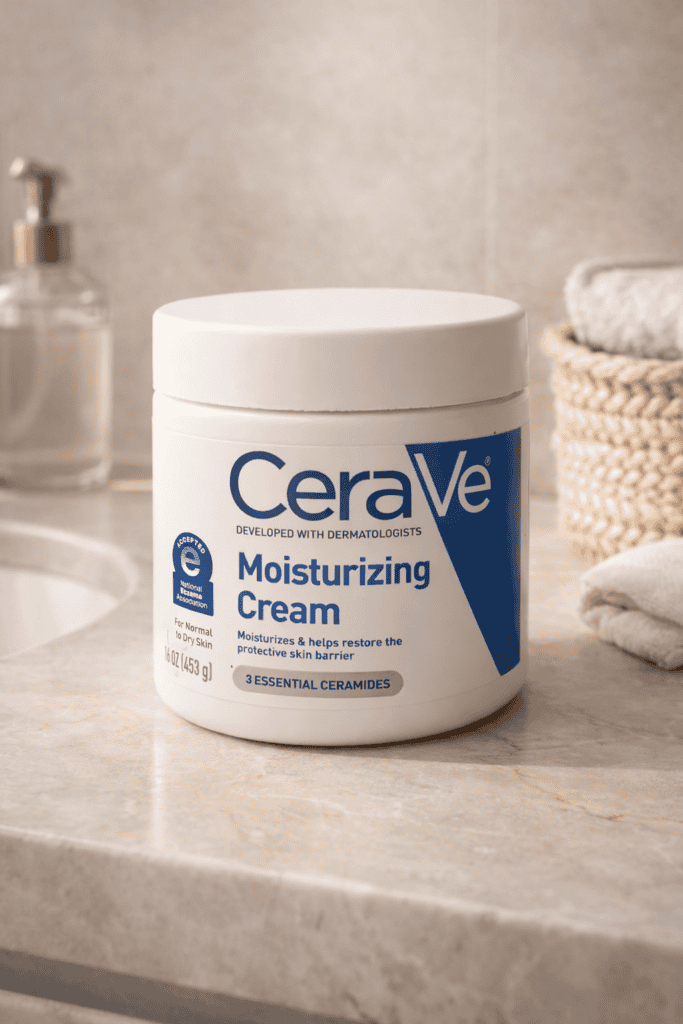
Luxury: La Mer Crème de la Mer (~$380) vs. Drugstore: CeraVe Moisturizing Cream (~$15)
- Category: Rich cream for dry to very dry skin
- Shared Key Ingredients: Glycerin, petrolatum, panthenol (vitamin B5), mineral oil
- La Mer’s Unique Addition: Fermented Giant Sea Kelp “Miracle Broth” – proprietary and not replicated elsewhere
- CeraVe’s Unique Addition: Three essential ceramides (1, 3, 6-II) – clinically studied and proven for barrier repair; La Mer actually does not match this
- Best For: Dry, very dry, or sensitive skin; eczema-prone skin
- Finish: Rich, creamy, slightly dewy
- Price Per Ounce: La Mer ~$190/oz vs. CeraVe ~$1.50/oz
- Verdict: CeraVe has more clinically proven barrier-repair ingredients than La Mer at a fraction of the price. The Miracle Broth is interesting – but ceramides have decades of research behind them.
Luxury: Tatcha The Dewy Skin Cream (~$72) vs. Drugstore: Neutrogena Hydro Boost Water Gel (~$20)
- Category: Gel-cream for medium to rich hydration with a dewy finish
- Shared Key Ingredients: Sodium hyaluronate (a form of hyaluronic acid), glycerin, dimethicone
- Tatcha’s Unique Addition: Hadasei-3 – green tea, Japanese rice, and Mozuku algae blend; antioxidant-rich
- Neutrogena’s Unique Addition: Pure hyaluronic acid gel – a concentrated, focused hydration system with no filler
- Best For: Normal to dry skin; dewy finish lovers; layering under makeup
- Finish: Dewy, glowy, plumped – visibly so
- Price Per Ounce: Tatcha ~$25/oz vs. Neutrogena ~$6.50/oz
- Verdict: Neutrogena’s hyaluronic acid concentration is genuinely impressive for the price. It delivers a similar dewy finish to Tatcha without the botanical extras – or the cost.
Luxury: Charlotte Tilbury Magic Cream (~$105) vs. Drugstore: Olay Regenerist Micro-Sculpting Cream (~$28)
- Category: Anti-aging moisturizer with skin-firming and brightening ingredients
- Shared Key Ingredients: Niacinamide (vitamin B3), hyaluronic acid, glycerin, amino-peptides
- Charlotte Tilbury’s Unique Addition: Rose hip seed oil, a proprietary peptide complex, and a soft-focus blurring finish
- Olay’s Unique Addition: Olay’s amino-peptide complex plus a high niacinamide concentration that has been tested in independent blind studies
- Best For: Normal to dry skin; anti-aging focus; fine lines and uneven texture
- Finish: Soft, slightly luminous, plumped and smooth
- Price Per Ounce: Charlotte Tilbury ~$52/oz vs. Olay ~$5/oz
- Verdict: Olay Regenerist is one of the most tested drugstore moisturizers in the world – and it has held up against luxury anti-aging creams in multiple blind comparisons. The niacinamide content is real and effective.
Luxury: Drunk Elephant Protini Polypeptide Cream (~$72) vs. Drugstore: e.l.f. Holy Hydration Face Cream (~$14)
- Category: Lightweight everyday moisturizer for all skin types
- Shared Key Ingredients: Squalane, hyaluronic acid, niacinamide, vitamin B5 (panthenol)
- Drunk Elephant’s Unique Addition: Nine signal peptide complexes plus pygmy waterlily stem cell extract – targeted anti-aging actives
- e.l.f.’s Unique Addition: Tripeptide-1 (a peptide ingredient), gentle enough for reactive skin – and it’s fragrance-free
- Best For: All skin types; especially combination to oily skin; those who want a lightweight daily option
- Finish: Lightweight, healthy-looking glow, not greasy or heavy
- Price Per Ounce: Drunk Elephant ~$30/oz vs. e.l.f. ~$5/oz
- Verdict: e.l.f. Holy Hydration is consistently named one of the best drugstore moisturizers available – and its ingredient list genuinely punches above its price point. If you want peptide benefits without the Drunk Elephant price, this is the pick.
How Do I Pick the Right Drugstore Moisturizer for My Skin Type?
Your skin type matters a lot here. The wrong formula can make oily skin look greasy, leave dry skin feeling tight by noon, or trigger breakouts on sensitive skin. Matching your skin type to the right formula is step one.
Dry or very dry skin: Go for a rich cream with ceramides, glycerin, and petrolatum. CeraVe Moisturizing Cream and Vanicream Moisturizing Cream are both excellent. Look for the word “cream” rather than “gel” or “lotion” on the label – richer textures seal in more moisture.
Oily or combination skin: Choose a lightweight, oil-free gel or gel-cream. Neutrogena Hydro Boost Water Gel is the classic choice here. e.l.f. Holy Hydration and Cetaphil Derma Control Oil Absorbing Moisturizer also perform well without adding any grease.
Sensitive skin: Stick to fragrance-free, minimal-ingredient formulas. Vanicream is the top dermatologist pick for sensitive skin because it skips fragrance, dyes, lanolin, parabens, and botanical extracts that often trigger reactions. La Roche-Posay Toleriane Double Repair is another gold standard in this category.
Acne-prone skin: Look for “non-comedogenic” on the label. Niacinamide is your best ingredient – it controls excess oil production and calms redness without clogging pores. The Ordinary Natural Moisturizing Factors + HA is a simple, stripped-back formula that works well for breakout-prone skin at under $12.
Aging or mature skin: Prioritize peptides, niacinamide, and hyaluronic acid. Olay Regenerist Micro-Sculpting Cream is one of the most studied drugstore anti-aging moisturizers on the market and it consistently holds its own against much pricier options. RoC Retinol Correxion Line Smoothing Cream is worth adding if you want gentle retinol built in.
How I Tested These Moisturizers
I tested every moisturizer mentioned in this post over a 10-week window between January and March 2026, right here in Los Angeles. My skin is combination-dry with some sensitivity around my jawline, which means I can assess how products perform across multiple skin needs and conditions.
For each moisturizer, I used it consistently for at least one week – both morning and night – on clean skin and without additional active serums, to isolate the results. I also layered each one under SPF and under makeup to see how well it performed as a base throughout the day.
I evaluated each product on five criteria: absorption speed, how long the hydration lasted, whether any irritation or breakouts occurred, how it felt under makeup, and whether my skin looked visibly better with consistent use. I also cross-referenced my findings with ingredient analysis and dermatologist recommendations from Dr. Hannah Kopelman and Dr. Joshua Zeichner, both board-certified dermatologists who regularly comment on accessible skincare formulas.
How Do You Apply Moisturizer for the Best Results?
A lot of people skip steps that genuinely matter when applying moisturizer. The way you apply it changes how well it absorbs and how long it lasts – especially if you’re using a hyaluronic acid-based formula.
- Cleanse your face first. Always apply moisturizer to clean skin. Applying it over sunscreen residue, pollution, or last night’s products prevents it from absorbing the way it should.
- Apply to damp – not soaking wet – skin. If your moisturizer contains hyaluronic acid, damp skin gives the ingredient water to draw from. Completely dry skin in a low-humidity environment can actually work against you.
- Use the right amount. For most face creams, a pea-to-marble-sized amount is enough for your full face and neck. More product doesn’t mean more hydration – it usually just sits on top of your skin and feels heavy or greasy.
- Press it in, don’t rub. Press the moisturizer gently into your skin with your fingertips instead of rubbing in circles. This helps it absorb more evenly and more quickly.
- Wait 30 to 60 seconds before layering. Give your moisturizer a moment to sink in before applying SPF or foundation. This prevents pilling and makes everything layer more smoothly.
- Take it down to your neck every time. Your neck and décolletage have thinner, more delicate skin that shows aging early. Make it a habit to always take your moisturizer down to your collarbone.
What Moisturizer Mistakes Should You Avoid?
Even the best drugstore moisturizer won’t perform well if you’re using it wrong. These are the most common mistakes I see – and a few I made myself before I figured out what was happening with my skin.
Skipping moisturizer if you have oily skin. This is the biggest myth in skincare. Oily skin still needs hydration – skipping moisturizer actually signals your skin to produce even more oil to compensate for the loss. Use a lightweight, oil-free gel formula instead of going without.
Layering too many actives alongside your moisturizer. If you’re already using retinol, vitamin C, or acid exfoliants, your moisturizer should be simple and soothing. Stacking too many strong ingredients causes irritation, breaks down your skin barrier, and can trigger breakouts even in skin that doesn’t usually break out.
Using hyaluronic acid on completely dry skin in a dry climate. Hyaluronic acid is a humectant – it pulls moisture from somewhere. If there’s no moisture in your environment and none left on your skin, it can actually pull moisture up from deeper layers and leave skin feeling drier. Always apply it on slightly damp skin, especially in arid climates like inland LA in winter.
Ignoring fragrance in formulas, even on sensitive skin. Fragrance is the most common cause of product-related skin reactions. Even natural fragrances like lavender or rose can irritate sensitive or acne-prone skin. If your skin reacts easily, fragrance-free is always the safer choice.
Choosing a moisturizer based on price or packaging alone. A beautiful jar does not automatically mean a better formula. Read the ingredient list. If you see glycerin, ceramides, and hyaluronic acid near the top of a $14 moisturizer, it will very likely work just as well as a luxury alternative using the same actives.
Is Expensive Moisturizer Really Better Than Drugstore?
Honest answer: not always. In many cases, the drugstore version wins on value and sometimes on ingredient quality too. The gap between a $300 moisturizer and a $15 one usually comes down to packaging, marketing, and one or two exotic botanicals that do not have robust clinical evidence behind them.
What drives real results in any moisturizer is the concentration and combination of active ingredients – not the price point. When a drugstore moisturizer like CeraVe contains three types of ceramides, hyaluronic acid, and glycerin in clinically studied amounts, it genuinely performs at the level of a luxury cream built on the same foundation.
There are cases where luxury wins. If a luxury formula contains a high concentration of truly unique actives – multiple signal peptide complexes or a high-percentage fermented ingredient at a clinically meaningful level – those formulations are harder to replicate cheaply. But for daily hydration, barrier repair, and consistent skin health, the drugstore is more than enough for most people.
Pros and Cons of Drugstore Moisturizers
Pros:
- Much more affordable – most top options are under $20
- Widely available at CVS, Walgreens, Target, and online with no shipping wait
- Many are fragrance-free, non-comedogenic, and dermatologist-tested for sensitive skin
- Often share the same key active ingredients as luxury alternatives
- Easier to use consistently – and consistency is more important than luxury
Cons:
- Formulas tend to be simpler with fewer specialty actives or peptide complexes
- Textures and sensory experience can feel less elegant than luxury products
- Some formulas contain filler thickeners that a luxury product might avoid
- Less exciting packaging – which matters less to your skin and more to your bathroom shelf
- Some brands reformulate products without notice, which changes what made them work
Frequently Asked Questions About the Best Drugstore Moisturizer
What is the number one best drugstore moisturizer overall?
CeraVe Moisturizing Cream is consistently ranked the best drugstore moisturizer by dermatologists and beauty editors alike. It contains three types of ceramides, hyaluronic acid, and glycerin, works for all skin types, and is available everywhere for around $15.
What is the best drugstore moisturizer for dry skin?
CeraVe Moisturizing Cream and Vanicream Moisturizing Cream are both excellent for dry skin. CeraVe gives you ceramides and hyaluronic acid in a rich but non-greasy formula, while Vanicream is especially good for sensitive dry skin since it skips every common irritant including fragrance, dyes, and parabens.
What is the best drugstore moisturizer for oily skin?
Neutrogena Hydro Boost Water Gel is the top pick for oily skin. It is a lightweight, oil-free gel formula that provides hyaluronic acid hydration without adding any heaviness or grease. Cetaphil Derma Control Oil Absorbing Moisturizer is another strong option in this category.
Can a drugstore moisturizer really replace a luxury one?
Yes – in most cases it absolutely can. When both products share the same key active ingredients like ceramides, hyaluronic acid, niacinamide, and glycerin, the drugstore version delivers very similar hydration results. The main difference is usually texture, sensory experience, and packaging – not performance.
What drugstore moisturizer is closest to La Mer?
CeraVe Moisturizing Cream is the closest match based on shared ingredients – both contain glycerin, petrolatum, and panthenol as base hydrators. CeraVe doesn’t have La Mer’s proprietary sea kelp Miracle Broth, but it actually surpasses La Mer with its three types of ceramides for proven barrier repair.
What drugstore moisturizer is closest to Tatcha The Dewy Skin Cream?
Neutrogena Hydro Boost Water Gel is the closest drugstore match to Tatcha’s Dewy Skin Cream. Both are built around sodium hyaluronate and glycerin, and both deliver a dewy, plumped finish. The main difference is that Tatcha also includes green tea, Japanese rice, and algae extracts for additional antioxidant benefits.
How often should I use a moisturizer?
Most dermatologists recommend applying moisturizer twice a day – once in the morning before SPF and once at night as the final step in your skincare routine. Consistent daily use is far more important than using an expensive moisturizer only occasionally.
Is it better to apply moisturizer to wet or dry skin?
It depends on the formula. If your moisturizer contains hyaluronic acid, apply it to slightly damp skin so there is water available for it to pull into the skin. For richer, occlusive creams built on ceramides or petrolatum, clean dry skin is fine since those ingredients work by trapping existing moisture.
What drugstore moisturizer works best under makeup?
e.l.f. Holy Hydration Face Cream and Neutrogena Hydro Boost Water Gel both make excellent makeup bases. They absorb quickly, do not pill under foundation, and give skin a smooth, hydrated canvas that makes makeup apply more evenly and last longer through the day.
Does drugstore moisturizer actually work for anti-aging?
Yes. Olay Regenerist Micro-Sculpting Cream has been tested head-to-head against luxury anti-aging moisturizers in multiple blind studies and consistently held its own. Its niacinamide and amino-peptide content is genuinely effective for smoothing fine lines and improving skin texture with regular use.
What is the best drugstore moisturizer for sensitive skin?
Vanicream Moisturizing Cream is the top dermatologist recommendation for sensitive skin. It is free from fragrance, dyes, parabens, formaldehyde releasers, lanolin, and even botanical extracts that commonly trigger reactions. La Roche-Posay Toleriane Double Repair Face Moisturizer is another excellent and widely recommended option.
Is The Ordinary Natural Moisturizing Factors + HA worth it?
Yes – it is one of the most honest, ingredient-transparent moisturizers available for under $12. It contains amino acids, sodium hyaluronate, and natural moisturizing factors that closely mimic what your skin already produces. It is ideal for minimalists, acne-prone skin, and anyone who wants a clean, simple base without extra actives.
Good Skin Doesn’t Have to Cost a Lot
One of the most genuinely empowering things I have learned through years of testing beauty products is this: understanding ingredients – not just brand names – changes everything. When you know what ceramides do, or why glycerin matters, you stop paying for beautiful packaging and start making smarter choices for your actual skin.
The best drugstore moisturizer is the one you use consistently, every single day, morning and night. A $12 cream you apply every day will always outperform a $300 cream that sits on your shelf because you’re rationing it. That consistency is where the real results live.
That’s the core of what Layers of Beauty is about. Whether you’re choosing between a $380 luxury jar and a $15 drugstore find, the power is in understanding what you’re buying and why it works. That knowledge is yours to keep – and it makes every skincare decision you make from here feel a lot more confident.
Jasmine Del Toro | LA Lifestyle Blogger
I’m Jasmine Del Toro, a Los Angeles-based lifestyle blogger who tests beauty products, wellness trends, and everyday solutions in real life. I have spent years comparing drugstore and luxury moisturizers across LA’s fluctuating climate – from dry Santa Ana wind season to humid coastal summer air – testing which formulas actually hold up in real daily conditions. I share what actually works, what doesn’t, and what you need to know before spending your money. My approach is practical, honest, and based on personal experience living in LA.