
This post contains affiliate links. If you purchase through my links, I may earn a small commission at no extra cost to you. I only recommend products I have personally tested and genuinely love.
Published July 23, 2026 · Last updated July 23, 2026
I have washed my hair on a Tuesday and had it looking greasy by Wednesday lunchtime. That is just what fine hair does.
Dry shampoo is what stands between me and washing every single day. Used well it buys you two extra days and your hair still looks clean.
Used badly it leaves a grey cast, a gritty scalp, and hair that somehow looks worse than when you started.
I have been testing dry shampoos across LA summers since 2024, which is about the harshest test there is for oily roots and dry ends at the same time.
This post sits alongside my complete hair care routine, which is the bigger picture of how I actually wash and treat my hair. If your wash days are the problem, my guide to the best sulfate-free shampoos and my picks for dry, damaged hair are the two to read next, and the hair oils I use for shine cover the other end of the problem.
What Is Dry Shampoo?
Dry shampoo is a powder or spray that absorbs oil at the roots so hair looks freshly washed without water. It matters because washing every day strips the scalp and can leave hair drier and more brittle over time. It is most useful for anyone with fine or oily hair, anyone stretching time between washes, and anyone who works out mid-week.
The Short Answer
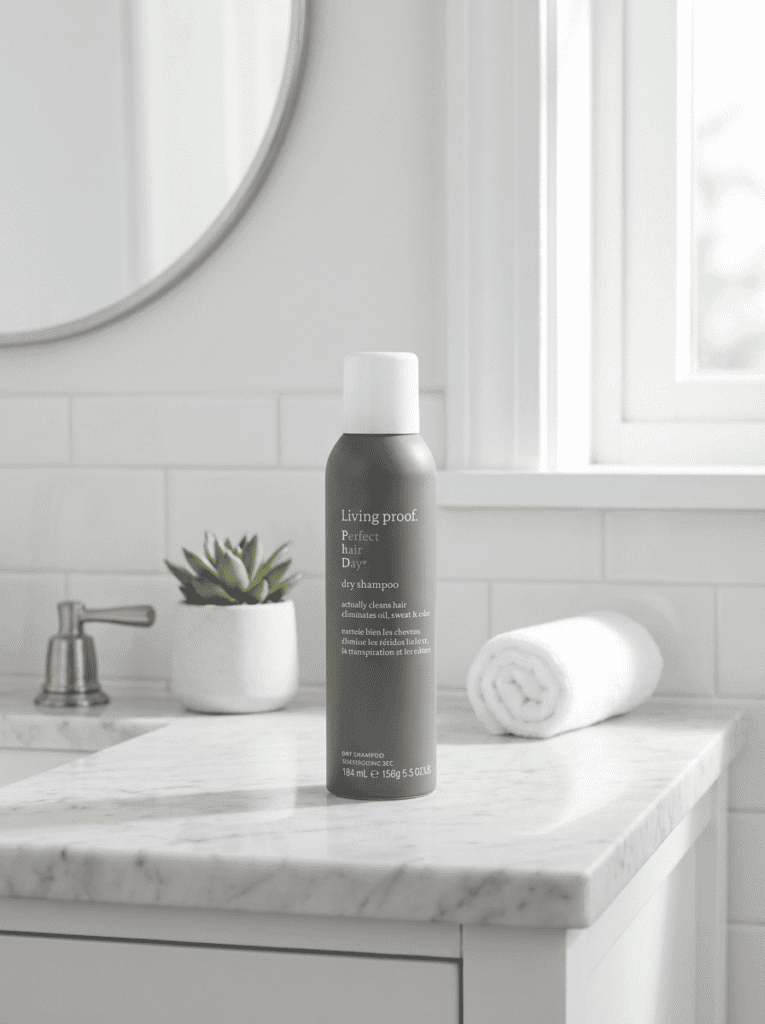
The best dry shampoo for most people is Living Proof Perfect Hair Day, because it absorbs oil without leaving a white cast or a gritty texture. Batiste is the best budget option at under ten dollars, and Briogeo Scalp Revival is the one to pick if your scalp gets itchy or flaky.
Quick Takeaways
- Spray at the roots, never at the lengths.
- Hold the can 8 to 10 inches from your scalp.
- Wait two minutes before you touch or brush it.
- Apply at night for better results by morning.
- Dry shampoo absorbs oil, it does not clean hair.
- Wash properly at least twice a week regardless.
What This Guide Covers
- What Is Dry Shampoo and How Does It Work?
- What Are the Best Dry Shampoos?
- How Do You Use Dry Shampoo Properly?
- Should You Apply Dry Shampoo at Night?
- Spray vs Powder vs Foam: Which Should You Use?
- What Mistakes Should You Avoid With Dry Shampoo?
- How Often Can You Use Dry Shampoo?
- How I Tested These
- Frequently Asked Questions
TL;DR – Living Proof Perfect Hair Day absorbs oil properly and disappears into dark hair without the grey film most dry shampoos leave behind. Batiste is genuinely good for under ten dollars if you are not fussy about scent. Pick Briogeo Scalp Revival if your scalp gets itchy, because it is the only one here built around scalp health.
One premium, one budget, one for sensitive scalps. These are the three I actually keep in rotation.
What Is Dry Shampoo and How Does It Work?
Dry shampoo absorbs oil at the roots using starch, clay, or charcoal so hair looks clean without water. It does not wash anything.
That distinction matters more than people realise. Dry shampoo soaks up the oil sitting on your scalp and hair, then you brush the powder out and the oil goes with it.
What it does not do is remove sweat, product buildup, or dead skin. Those still need water and actual shampoo.
Most sprays use rice starch or aluminium starch as the absorbent. Powder versions often use clay, and scalp-focused ones like Briogeo use charcoal.
The reason to bother at all is that washing daily is hard on hair. The American Academy of Dermatology's healthy hair guidance is clear that how often you need to wash depends on your hair and scalp type, not on a rule that everyone should wash every day.
Stretching your washes is also easier on colour and on damaged ends, which is why dry shampoo shows up in almost every damaged-hair recovery plan I have written.
What Are the Best Dry Shampoos?
These are the three I keep buying, chosen to cover three different problems rather than three versions of the same thing. One premium, one budget, one for sensitive scalps.
This is the one that changed my mind about dry shampoo. It uses a cleansing powder that absorbs oil and then brushes out, so it lifts residue instead of just burying it. On my dark hair it leaves no cast at all, which is the single hardest thing for a dry shampoo to get right.
Shop Now →Batiste is the one most people start with and it genuinely earns its place. It absorbs oil fast and costs under ten dollars, which makes it easy to keep one in a gym bag and one in the car. The trade-off is a heavier scent and a visible cast on dark hair if you are careless with it.
Shop Now →Charcoal absorbs oil and the formula is built around scalp comfort rather than just soaking up grease. If dry shampoo usually leaves your scalp itchy or flaky, this is the one to try. It is the most expensive of the three and worth it only if scalp irritation is your actual problem.
Shop Now →A few others are worth knowing by name even though I am not linking them here. Amika Perk Up is the one people reach for when they want volume as well as oil absorption.
Klorane makes an oat milk version that is popular with anyone whose scalp reacts to everything else. Kristin Ess and Ouai both make solid mid-price sprays.
None of those beat the three above for me, but if you already own one you are not doing anything wrong.
How Do You Use Dry Shampoo Properly?
Most dry shampoo complaints are application problems, not product problems. Spray at the roots from a distance, wait, then brush.
How to Apply Dry Shampoo, Step by Step
-
1
Start with dry hair. Dry shampoo on damp roots turns into paste.
-
2
Section your hair so you can actually see your scalp. Lifting a few sections beats spraying at the surface.
-
3
Hold the can 8 to 10 inches away and spray the roots in short bursts. Close is what causes the white cast.
-
4
Target only the oily areas, usually the crown, the part, and the hairline. Skip the lengths entirely.
-
5
Wait two full minutes. This is the step nearly everyone skips and it is the one that matters most.
-
6
Massage it in with your fingertips, then brush it through properly to distribute and remove residue.
That two-minute wait is doing real work. The powder needs time to absorb the oil before you move it around.
Brush immediately and you are just spreading white powder over greasy hair, which is exactly the look everyone is trying to avoid.
Should You Apply Dry Shampoo at Night?
Yes, and it is the single easiest upgrade to your results. Applying at night gives the powder all night to absorb oil.
You wake up with roots that look genuinely clean rather than freshly powdered. There is no white cast to manage because it has had hours to work in.
I do this the night before a wash-day skip. It takes thirty seconds before bed and saves me ten minutes in the morning.
It also means you are not spraying anything near your face when you are already dressed and made up.
If you only change one thing from this whole post, change the timing.
Spray vs Powder vs Foam: Which Should You Use?
The format changes how much control you have and how it feels on your scalp. Here is how the three compare.
Aerosol Spray
- Best for: Speed and even coverage
- Control: Lower, easy to overdo
- Cast risk: Highest on dark hair
- Travel: Restricted in carry-on above certain sizes
- Feel: Light, sometimes cooling
- Pick if: You want fast roots refresh with minimum effort
Loose or Pressed Powder
- Best for: Precision at the part and hairline
- Control: Highest, you place it exactly
- Cast risk: Low if you build slowly
- Travel: No aerosol restrictions
- Feel: Can feel gritty if overapplied
- Pick if: You have dark hair or only get oily in one spot
Foam
- Best for: Adding grip and a little volume
- Control: Medium, worked in by hand
- Cast risk: Very low, nothing to leave behind
- Travel: Fine, but heavier to carry
- Feel: Slightly damp then dries down
- Pick if: Sprays make your scalp itch
For most people a spray is the right default. It is fastest and the formulas have improved a lot.
If you have dark hair and have been burned by white cast before, a powder gives you far more control over placement.
What Mistakes Should You Avoid With Dry Shampoo?
The biggest mistake is spraying too close. Six inches feels natural and it is exactly what deposits a visible white patch.
The second is brushing straight away. Give it the two minutes or you are just moving powder around.
Do not spray the lengths of your hair. Your ends are the driest part and dry shampoo makes them drier and duller.
Do not use it on already-sweaty hair after a workout. It clumps, and sweat needs washing out rather than absorbing.
Do not layer it day after day without washing. Buildup at the scalp is what causes the itching people blame on the product.
Do not treat it as a substitute for washing. It buys you time, and that is all it does.
And do not skip heat protection just because you skipped the wash – if you are restyling second-day hair with hot tools, a heat protectant still matters.
How Often Can You Use Dry Shampoo?
Two consecutive days is a sensible ceiling, and you should be washing properly at least twice a week.
Beyond that you get buildup at the roots, and buildup is what leads to itching, flaking, and hair that will not hold a style.
The pattern that works for me is wash, dry shampoo, dry shampoo, wash. That gives me four or five wash days a week down to two or three.
If your scalp starts feeling tight or itchy, that is your signal to wash rather than to spray again.
How often you need to wash in the first place depends on your hair type and scalp, and MedlinePlus covers the common hair and scalp problems worth ruling out if yours is behaving unusually.
If you are trying to grow your hair out, stretching washes helps – my post on what actually works for hair growth goes into why less manipulation matters.
How I Tested These
I have used dry shampoo consistently since 2024 and tested more than a dozen formulas across that time. These three are the ones still in my bathroom.
My hair is fine, dark, and gets oily at the roots by day two. That combination is the hardest case for dry shampoo because fine hair goes flat and dark hair shows every trace of white cast.
I tested each one the same way. Night application on clean day-two roots, brushed out the next morning, worn through a full LA day.
The three things I judged were oil absorption at the crown, visible cast in daylight, and how my scalp felt by the end of the day.
Living Proof won on all three, which is why it is the pick even though it is not the cheapest.
I have written more about that brand in my full Living Proof review if you want to know which of their other products are actually worth it.
Frequently Asked Questions
What is the best dry shampoo?+
Does dry shampoo actually clean your hair?+
How do you use dry shampoo without the white cast?+
Should you use dry shampoo at night or in the morning?+
Is dry shampoo bad for your hair?+
Can you use dry shampoo on wet hair?+
Does dry shampoo work on dark hair?+
Is dry shampoo good for oily hair?+
Can you use dry shampoo after the gym?+
How long does dry shampoo last?+
Is spray or powder dry shampoo better?+
Does dry shampoo cause hair loss?+
The Bottom Line
Fine or dark hair, go Living Proof. Tight budget, go Batiste. Itchy or flaky scalp, go Briogeo.
Dry shampoo is not glamorous. It is a practical fix for a practical problem, and that is exactly why it is worth getting right.
There is something quietly freeing about not being tied to a wash schedule. You stop planning your week around your hair.
That is the version of beauty I actually care about. Not the products that promise to transform you, but the ones that give you back twenty minutes and let you leave the house feeling like yourself.
Fine hair on day three is not a character flaw. It is just hair, and there is a spray for that.
If you want to fix the root cause rather than manage it, my complete hair care routine is where I would start.
Sources & Further Reading
Keep Reading on Layers of Beauty
Jasmine Del Toro | LA Lifestyle Blogger
I'm Jasmine Del Toro, a Los Angeles-based lifestyle blogger who tests beauty products, wellness trends, and everyday solutions in real life. I have fine, dark hair that gets oily at the roots by day two, so I have been testing dry shampoos through LA summers since 2024 looking for one that absorbs oil without leaving a grey film. I share what actually works, what doesn't, and what you need to know before spending your money. My approach is practical, honest, and based on personal experience living in LA.
This post may contain affiliate links – I only recommend products I have personally used and believe in.