
This post contains affiliate links. If you purchase through my links, I may earn a small commission at no extra cost to you. I only recommend products I have personally tested and genuinely love.
Published September 6, 2026 · Last updated September 6, 2026
I have bought a lot of body mists that smelled incredible in the store and like nothing at all by lunchtime. For a while I assumed I was buying the wrong brands.
I was actually buying the wrong structure. A mist that smells expensive and a mist that smells cheap can cost the same and sit at the same concentration.
The difference is what is holding the scent up underneath, and once I understood that I stopped wasting money almost immediately.
If fragrance is a category you are still working out, a few other guides here will help: how to find your signature scent is the place to start, how to layer perfume covers stretching what you own, how to make perfume last longer goes deep on the longevity mechanics I only summarise here, and my summer perfume picks and best perfumes for women cover the fine-fragrance tier above this one.
What Is a Body Mist?
A body mist is a lightly concentrated fragrance, typically 1 to 3 percent fragrance oil in an alcohol and water base, designed to be sprayed generously over the body rather than dabbed on pulse points. It matters because that low concentration is why mists cost less and fade faster than perfume, and why the ones with real base notes stand out so sharply. It is most useful for anyone who wants to wear scent casually, layer it under a stronger fragrance, or refresh partway through the day.
The Short Answer
Body mists smell expensive when they are base-weighted rather than top-heavy. A mist carries 1 to 3 percent fragrance oil against 15 to 20 percent in an eau de parfum, so the small amount it has must go into heavy base notes like amber, musk, vanilla, sandalwood or tonka. Those notes persist longest and slow everything above them.
Quick Takeaways
- Body mists hold 1 to 3 percent fragrance oil; eau de parfum holds 15 to 20 percent.
- Expensive-smelling mists are base-weighted, not top-heavy.
- Look for amber, musk, vanilla, sandalwood or tonka in the base.
- Moisturise first: dry skin loses scent faster than hydrated skin.
- Hair and fabric hold fragrance far longer than skin does.
- Judge a mist at hour three, never at the moment you spray it.
What This Guide Covers
- Why Do Most Body Mists Smell Cheap?
- What Makes a Body Mist Smell Expensive?
- Which Body Mists Smell the Most Expensive?
- How Do You Make a Body Mist Last Longer?
- When Should You Buy the Perfume Instead?
- Mistakes to Avoid When Buying a Body Mist
- Are Body Mists Safe for Sensitive Skin?
- How I Tested This
- Frequently Asked Questions
Why Do Most Body Mists Smell Cheap?
Most body mists smell cheap because they contain roughly one tenth the fragrance oil of an eau de parfum. A body mist typically carries 1 to 3 percent fragrance oil, against 5 to 15 percent for an eau de toilette, 15 to 20 percent for an eau de parfum and 20 to 30 percent for a pure parfum. It is not a worse scent, it is a lower dose.
That dose difference shows up as time on skin. A body mist usually lasts 2 to 4 hours. An eau de toilette runs 3 to 5, an eau de parfum 5 to 8, and a parfum can go past 24.
But concentration alone does not explain the cheap smell. Plenty of 2 percent mists smell expensive and plenty of pricey ones do not.
The Real Reason: Top-Heavy Versus Base-Weighted
A fragrance is built as a volatility ladder, not a metaphor. Top notes are the most volatile molecules and burn off in roughly 5 to 15 minutes. Heart notes hold for a few hours.
Base notes are the heaviest, least volatile molecules in the formula. Amber, musk, vanilla, sandalwood, tonka and oud sit here. They can persist past 24 hours, and they also act as fixatives that slow the evaporation of everything stacked above them.
Cheap-smelling mists are top-heavy. You get a loud fruity opening with almost nothing underneath it, so the whole thing collapses inside an hour.
Expensive-smelling mists are base-weighted. When you smell one and think it smells expensive, you are usually smelling a drydown rather than an opening.
What Makes a Body Mist Smell Expensive?
A body mist smells expensive when it scores well on three things: base-note weight, sillage control, and what is left at hour three. Those three axes explain almost every mist I have liked and almost every one I have returned. Price is not on the list, and after testing this way for three months I stopped trusting price entirely.
Here is the rubric I scored every mist against, and you can run it in a store aisle in about four minutes.
How to Run the Rubric in a Store
The Four-Minute Aisle Test
-
1
Read the note list before you spray. If the base has no amber, musk, vanilla, sandalwood or tonka in it, the mist will almost certainly not last. This one step eliminates half the aisle.
-
2
Spray once on your inner forearm, not a paper strip. Paper has no heat, no oil and no pH, so it tells you nothing about how the mist will behave on you.
-
3
Walk away for ten minutes. The alcohol flash-off is what you smell in the first two minutes and it is not the fragrance. Judging a mist at the moment of spraying is the most common mistake there is.
-
4
Come back and check projection. Hold your arm at normal distance. If you have to lift your wrist to your nose, that is a skin scent. If you could smell it from the next aisle, that is a room scent. Neither is wrong, but expensive usually means the first.
-
5
Set a phone timer for three hours. This is the only test that matters and it is the one nobody does in the store. If there is still something legible on your arm at hour three, buy it.
Which Body Mists Smell the Most Expensive?
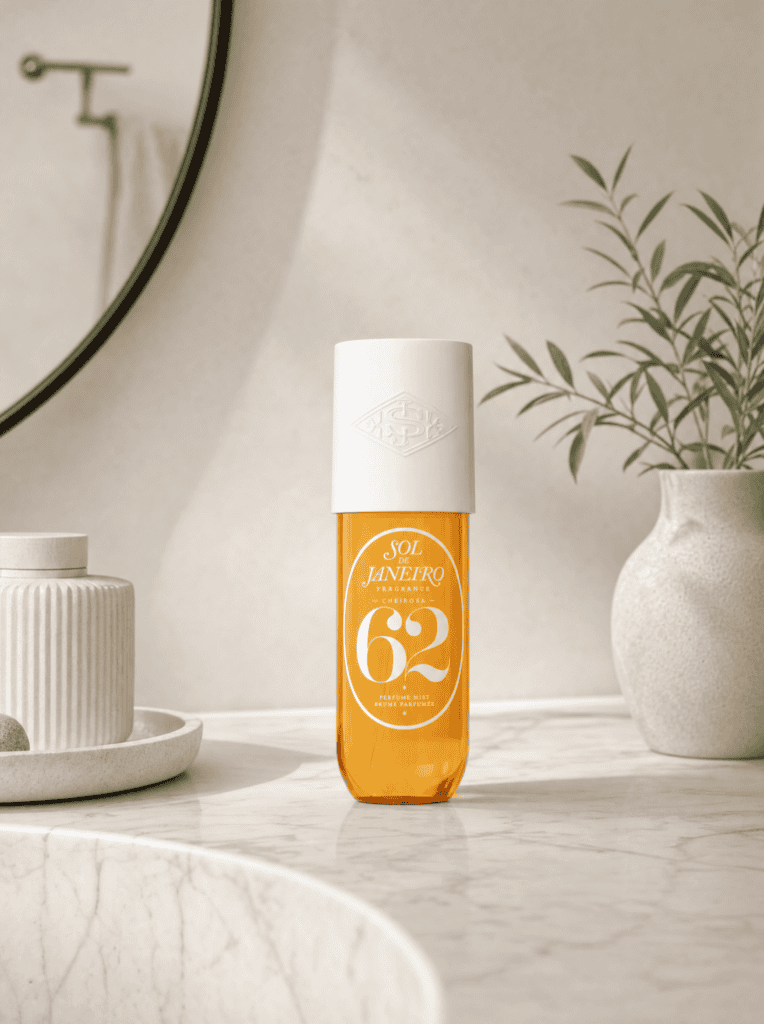
The body mists that smell most expensive as of September 2026 are Sol de Janeiro Cheirosa 62, Sol de Janeiro Beach Mist, Ariana Grande MOD Vanilla, Glossier You Fleur, and the two NEST New York perfume oils. Each one below carries a real base note and each one survived my hour-three check. They are ranked by how convincingly they pass as a fine fragrance.
Scores in each card are mine, on the 1 to 5 rubric above. I have kept the list short on purpose - six mists I actually reach for beat twenty I once sniffed.
Pistachio, salted caramel and vanilla over a heavy amber base. This is the mist that reads most convincingly as a real perfume, and the base is why: at hour three it is still there as a warm skin scent instead of vanishing. It scored 5/5 on base-note weight and 4/5 on hour-3 drydown.
Shop Now →Coconut, sea salt and jasmine with a soft musk underneath. Fresh mists usually die fastest because they are top-heavy, and this one avoids that trap: it held a legible scent at hour two on my forearm in September LA heat. Base-note weight 3/5, sillage 4/5.
Shop Now →Vanilla, coconut milk and a dry musk drydown. This is the cheapest thing on my list that still passed the hour-3 test, and it smells more expensive than it is because the vanilla is dry rather than sugary. Base-note weight 4/5, drydown 3/5.
Shop Now →Ambrette, pink pepper and a musk that shifts on skin. Glossier You sits so close to the body that people have to lean in, which is exactly the effect expensive fragrance is chasing. Sillage 2/5 by design and base-note weight 5/5, so buy it for compliments from one person rather than a room.
Shop Now →An oil rather than an alcohol mist, which changes the longevity math entirely. Oil has no alcohol flash-off, so the opening is quieter and the wear is longer, and it outlasted every alcohol mist I tested. Drydown 5/5, sillage 2/5.
Shop Now →Coconut, jasmine and vanilla in a rollerball that will not detonate in a carry-on. A rollerball also solves the spray-cloud problem covered further down this post. Base-note weight 4/5, drydown 4/5.
Shop Now →Shop the Expensive-Smelling Edit
My top three by base-note weight, which is the axis that predicts everything else.
One honest note on what is missing. Phlur Vanilla Skin, Salt and Stone Santal and Vetiver, Summer Fridays and Gisou all show up repeatedly across the roundups I read while researching this, and they deserve their reputations. I have not tested them long enough to score them on the rubric, so I have left them off rather than pad the list.
If you want the drugstore-price tier specifically, I broke that category down separately in my guide to the best Victoria’s Secret body mists, which covers the scents in that lineup that punch above their price.
How Do You Make a Body Mist Last Longer?
To make a body mist last longer, moisturise first with an unscented lotion, then spray onto skin that is still slightly damp. Fragrance oils need lipids to bind to, and dry skin has fewer of them, so scent lifts off faster. This one change did more for longevity in my testing than switching products did.
The American Academy of Dermatology recommends applying moisturiser to damp skin to trap water in. That same damp-skin window is the best moment to spray.
The Six-Step Longevity Routine
-
1
Shower with something that leaves skin conditioned. I use Salt and Stone Bergamot and Hinoki body wash or OUAI St. Barts body wash, both of which leave a base to build on rather than stripping it.
-
2
Moisturise while damp. An unscented lotion is ideal, but Sol de Janeiro Brazilian Bum Bum Cream works beautifully under any Cheirosa mist because the scents are built to layer.
-
3
Spray pulse points for projection. Wrists, inner elbows, base of the throat and behind the knees sit over surface blood vessels. That extra warmth pushes the scent outward, which raises projection but shortens duration.
-
4
Spray hair and clothing for duration. Fabric and hair hold scent far longer than skin because there is no body heat driving evaporation and no sebum reacting with the formula. This is the single biggest longevity lever in the whole routine.
-
5
Do not rub your wrists together. The friction and heat accelerate the top notes and crush the opening. Spray and let it sit.
-
6
Reapply at hour three, not hour six. Mists are a 2 to 4 hour product. Treating one like an eau de parfum is how people end up disappointed in a perfectly good bottle.
Two more things worth knowing. Skin pH, sweat and sebum all shift the drydown, which is why the same mist can smell different on you than on a friend.
And an oil-based fragrance sidesteps the alcohol flash-off completely, which is why both NEST oils above outlasted every alcohol mist I tested. If longevity is your only complaint, switch formats before you switch scents. I go deeper on this in how to make perfume last longer.
When Should You Buy the Perfume Instead?
Buy the perfume instead of the mist when you need the scent to survive a workday, when it is for an occasion rather than a Tuesday, or when you have re-bought the same mist three times in a year. At that third repurchase the mist has stopped being the cheap option. A $26 mist bought four times a year costs more than one bottle of eau de parfum you finish in two.
The concentration jump is what you are actually paying for. Going from a 2 percent mist to a 15 to 20 percent eau de parfum is close to a tenfold increase in fragrance oil, and that is the change that fixes longevity.
The reference point for the salty-mineral scent every drugstore mist imitates. A cologne runs roughly 2 to 4 percent fragrance oil, so it is closer to a mist in strength than most people assume - buy it for the quality of the materials, not the longevity.
Shop Now →Fruity-floral done with real depth. If your favourite mist is a peach or nectarine scent that dies in an hour, this is the version with a base underneath it.
Shop Now →A gourmand eau de parfum at roughly 15 to 20 percent oil. This is the concentration jump that actually fixes longevity, and I broke down how it wears in my Kayali review.
Shop Now →The clean-skin scent the entire mist category has been chasing since 2022. If you keep buying musky mists and finding them thin, this is what you actually want.
Shop Now →If you are trying to work out which direction to go before spending $138, my guide to finding your signature scent is the cheaper first step, and layering perfume covers how to stretch what you already own.
Mistakes to Avoid When Buying a Body Mist
The five mistakes that cost people the most money on body mists are judging the scent at the moment of spraying, testing on paper instead of skin, buying only top notes, spraying onto dry skin, and expecting perfume longevity from a 2 percent formula. Every one of them is avoidable in under a minute.
Pros
- Judge at ten minutes, not ten secondsThe first two minutes are alcohol evaporating. That sharp note is not the fragrance and it will not be there later.
- Test on your inner forearmPaper strips have no heat, no oils and no pH. They cannot tell you how a mist will behave on you.
- Read the base before the topAmber, musk, vanilla, sandalwood or tonka in the base is the single best predictor of an expensive read.
- Spray onto moisturised, damp skinFragrance oils bind to lipids. Dry skin has fewer, so the scent lifts off faster.
- Spray hair and fabric for durationBoth hold scent far longer than skin does, with no body heat driving it off.
Cons
- Buying because it smells strong in the storeStrong opening usually means top-heavy, which is the exact profile that dies fastest.
- Rubbing your wrists togetherFriction and heat crush the opening and speed up the whole evaporation curve.
- Expecting 8 hours from a mistA 1 to 3 percent formula is a 2 to 4 hour product. That is the design, not a defect.
- Spraying a whole cloud over your bodyMore product does not extend a top-heavy scent, and it raises your exposure to the sensitisers covered below.
- Assuming price predicts qualityAn $85 designer mist and a $22 drugstore one can sit at the same concentration. Base notes predict quality. Price does not.
Are Body Mists Safe for Sensitive Skin?
Body mists can trigger allergic contact dermatitis, and fragrance is one of the leading causes of it from cosmetics. Roughly 1 to 2 percent of the general population is allergic to fragrance ingredients, rising to 8 to 15 percent of people with eczema and 20 to 25 percent among patients patch-tested for suspected contact dermatitis. For a product you spray over your whole body, that is worth knowing.
The most frequent culprits are linalool and limonene hydroperoxides, oakmoss and treemoss absolute, isoeugenol, cinnamyl alcohol and cinnamal. Reactions typically show up on the face, neck, underarms and scalp, which is exactly where a mist lands.
Dermatologists describe something called the atomizer sign, a distribution pattern of fragrance dermatitis produced specifically by spray application. It is documented in the peer-reviewed literature and it is the reason a rollerball can be a genuinely better choice than a spray if your skin is reactive.
One labelling fact most people do not know. Under FDA rules, a manufacturer can list an entire proprietary scent blend under the single word fragrance or parfum. Dozens of individual materials can sit behind that one word.
That is not a reason to panic. It is the reason patch-testing matters if you already react to things, and why IFRA sets stricter safe-use limits for leave-on body products than for rinse-off ones.
If you know you are sensitive, spray clothing rather than skin, choose an oil rollerball over an atomiser, and talk to a dermatologist about patch testing. MedlinePlus has a plain-language overview of what allergic contact dermatitis actually looks like.
How I Tested This
I tested these body mists over three months in Los Angeles, from June through early September 2026, scoring each one on base-note weight, sillage and hour-3 drydown. Every mist was worn on skin for a full day at least three separate times. Nothing here was scored from a paper strip or a store sniff.
The protocol was the same every time. One spray on a clean, unscented inner forearm, then checks at ten minutes, one hour, three hours and six hours.
The ten-minute check exists because the first two minutes are alcohol, not fragrance. The hour-three check is the one that separated the list, and it is where most of the mists I tried dropped out.
A limitation worth stating plainly. Dry LA heat is a specific environment, and scent behaves differently in humidity. If you live somewhere humid, expect slightly longer wear and a heavier read on the gourmands.
“I stopped trusting price after week two. A $22 mist and an $85 mist can sit at the same concentration, and only one of them had a base note worth smelling at hour three.– Jasmine Del Toro, Layers of Beauty
Frequently Asked Questions
What body mist smells the most expensive?+
Sol de Janeiro Cheirosa 62 smells the most expensive of the mists I tested, because its pistachio and salted caramel opening sits on a genuinely heavy amber base. That base is what makes it read as a fine fragrance rather than a body spray. It was still legible on my skin at hour three, which most mists are not.
Why do body mists not last as long as perfume?+
Body mists do not last as long as perfume because they contain 1 to 3 percent fragrance oil, against 15 to 20 percent in an eau de parfum. That is close to a tenfold difference in dose. A mist is designed as a 2 to 4 hour product, so expecting all-day wear from one is expecting it to be something it is not.
How do you make a body mist smell more expensive?+
Moisturise with an unscented lotion first, then spray onto skin that is still slightly damp. Fragrance oils bind to skin lipids, so hydrated skin holds scent measurably longer than dry skin. Spraying your hair and clothing as well as your skin extends it further, because fabric has no body heat driving evaporation.
Is it better to spray body mist on skin or clothes?+
Spray skin for projection and clothes for duration. Pulse points sit over surface blood vessels, and that warmth pushes scent outward but burns through it faster, while fabric and hair hold fragrance considerably longer because there is no body heat and no sebum reacting with the formula. Using both is the practical answer.
What fragrance notes make something smell expensive?+
Amber, musk, vanilla, sandalwood, tonka and oud are the notes that read as expensive. All of them are base notes, meaning they are the heaviest and least volatile molecules in a formula. They persist longest and they slow the evaporation of the lighter notes above them, which is why base-weighted fragrances smell richer.
Are body mists bad for sensitive skin?+
Body mists can trigger allergic contact dermatitis in people who are sensitised to fragrance ingredients. Roughly 1 to 2 percent of the general population is affected, rising to 8 to 15 percent of people with eczema. If you react to fragrance, an oil rollerball on clothing is safer than an all-over spray, and a dermatologist can patch-test you.
Is a body mist worth it compared to buying perfume?+
A body mist is worth it if you want to wear a scent casually, layer it, or refresh during the day. It stops being the cheaper option once you re-buy the same bottle three or four times a year, since that outspends a single eau de parfum you would finish in two years.
How many sprays of body mist should you use?+
Two to four sprays is enough for a body mist. More product does not extend a top-heavy fragrance, because the problem is the formula rather than the quantity. Heavier application also raises your exposure to fragrance sensitisers across a much larger area of skin.
Do expensive body mists actually last longer?+
Not reliably. Price and concentration are only loosely related, and an $85 designer mist and a $22 drugstore one can sit at the same 2 percent. What predicts longevity is base-note weight, so read the note list before you read the price tag.
What is the difference between a body mist and a fine fragrance mist?+
Fine fragrance mist is a marketing term rather than a regulated one, and it usually signals a slightly higher oil load or better materials than a standard body spray. There is no fixed percentage attached to it. Judge the note list and the hour-three wear instead of the label.
The Bottom Line
The reason I care about this beyond the shopping is that scent is one of the fastest confidence levers there is. You put something on, you catch it on yourself an hour later, and you stand slightly differently.
That effect does not require a $150 bottle. It requires a scent with something underneath it, applied to skin that will actually hold it.
Understanding the structure is what turns a $26 mist into something that feels considered rather than cheap. That is the whole thesis of Layers of Beauty: knowing why something works is what lets you stop overspending to get the feeling you were after.
Start With One
If you buy a single thing off this list, make it the one with the heaviest base.
And if you want the drugstore tier specifically, start with my Victoria’s Secret body mist guide before you spend more.
Sources & Further Reading

About the AuthorJasmine Del Toro
I'm Jasmine Del Toro, a Los Angeles-based lifestyle blogger who tests beauty products, wellness trends, and everyday solutions in real life. I spent three months this summer scoring body mists on base-note weight and hour-three wear, which is how I finally worked out why some $22 mists outlast $85 ones. I share what actually works, what doesn't, and what you need to know before spending your money. My approach is practical, honest, and based on personal experience living in LA.
I'm an Amazon Influencer, an Icon-level ShopMy creator, and a brand ambassador for Revolve, Victoria's Secret, and DoorDash.
This post may contain affiliate links – I only recommend products I have personally used and believe in.